Mongolian Work Exchange 2: Orkhon Valley
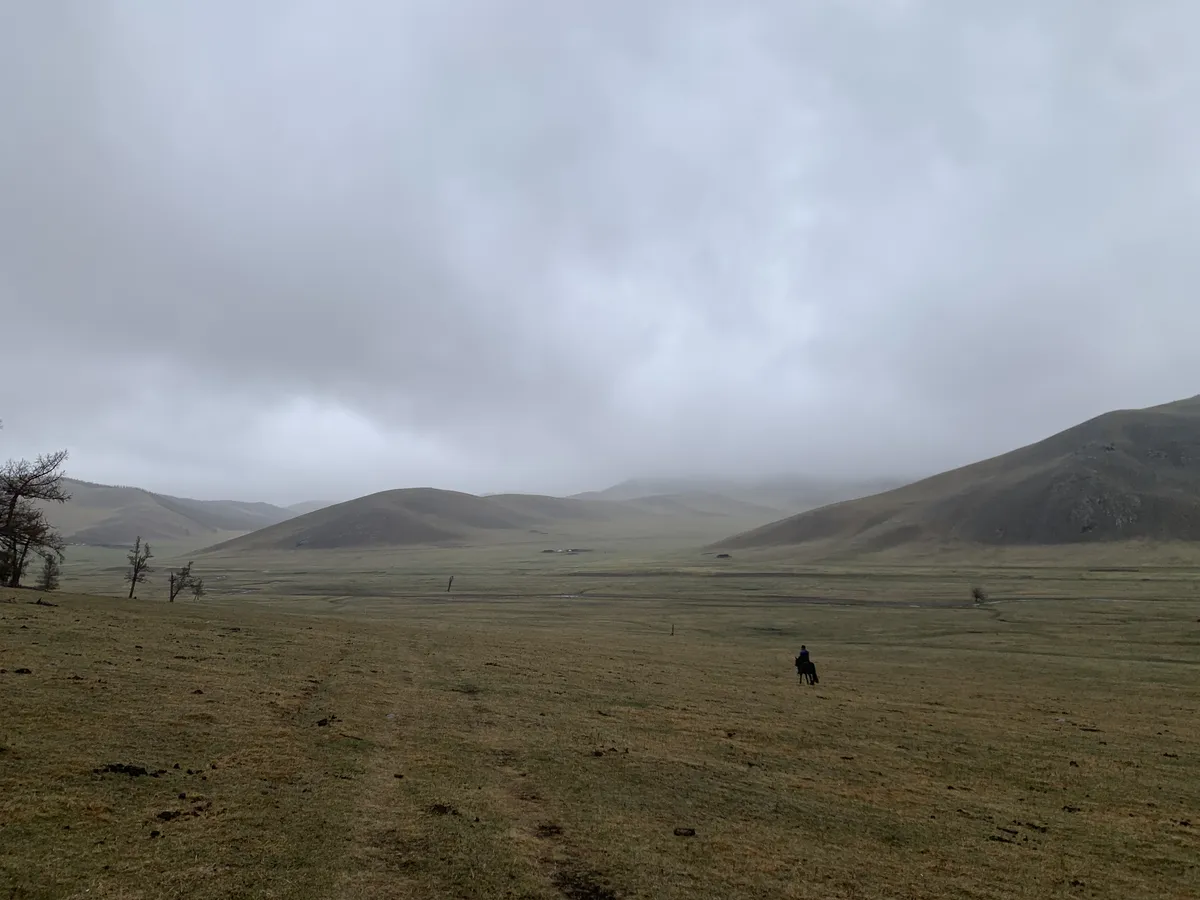
“Can you drive a motorcycle?”
This was what I woke up to at 6:30am, as I lay on the floor of a family’s yurt (ger in Mongolia) in the middle of the Orkhon Valley in Central Mongolia. It was said to me not by voice, but shown to me on Google Translate, which had been how I communicated with this family since we first met.
It was my 4th day staying with this nomadic family and today was the day to move from their winter location to their summer location. Everyone, and everything, needed to be moved. Thankfully I did know how to drive a motorcycle, having learnt in Taiwan many years earlier. I gave a nod of the head and off we went after breakfast.
Introduction
I had become associated with this family thanks to the website, worldpackers, as well as to my partner, who had found the posting online and who was laying next to me on the floor (and then later sitting behind me on the motorcycle). We had agreed to spend 7 nights with this family and to help out with their farm and nomadic living in exchange for food, accommodation, and some cultural exchanges. We had also paid $100USD as well to our worldpacker host, as she was the one who connected us with the family. She claimed to run an educational nonprofit and she said she uses the funds for that. We were bummed that the funds were not going to the family, as we would’ve preferred that, but she did seem great so I hope the funds are used well...
The family we stayed with lived deep in the Orkhon Valley, which is a UNESCO protected zone and a beautifully vast area of Mongolia. It is a place without any roads or barely any public infrastructure like running water or electricity cables (although some cables do exist randomly). Instead, what you get are rolling hills filled with animals, tire marks in the grass, and the occasional ger with some wooden farming structures adjacent to it. When you think of Mongolia’s wildness and nomadic lifestyles, you likely are thinking of this region. It is a common stop on Mongolian tours, so we were stoked to be able to stay there without visiting on a tour.
We were surprised to see that most homes/gers there had solar panels, with our family even having a satellite and wifi set up. Some families, it seems, are nomadic through the year, moving their gers and their animals as the seasons change, while others may have multiple houses or gers in the area, leaving their gers/houses where they are and instead only moving themselves along.
Our family was the latter, having a farm/winter ger, a summer camp, and a house in the nearby city, Bat-Olzii, which was about 45 minute drive away on a dry day. The mother and father of this family spent the winter in the farm ger with their youngest child (a 3 year old daughter, who was tough as nails), while their 3 other children all lived in the city house (which was an actual house) during the spring/fall/winter so they could go to school. When the summer came, all of the children and the parents would move to their summer ger, which was a larger ger in a much more open valley. To our surprise, they moved here as it acted as an easier location for hosting tourists, who start to pass through this area from mid-May to September on guided tours and horse tours.
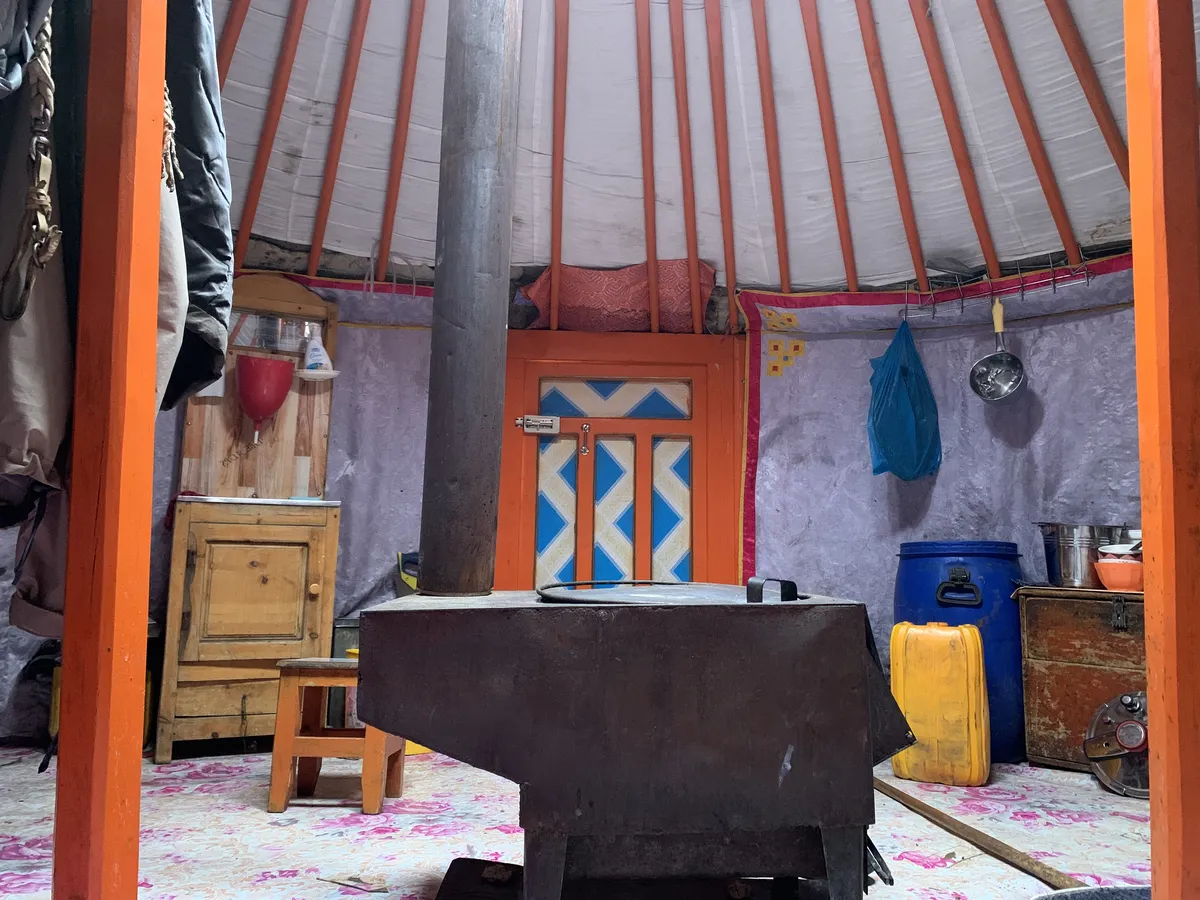 View inside our family's farm/winter ger from my bed on the floor
Parlez-vous français? Heh?
The entire family and all of their extended relatives and friends (well, at least all of those we met, which were a lot) did not speak English, instead speaking solely in Mongolian. Usually when I travel, if I meet an entire group of people (I’m talking like 30 people here), then you usually end up meeting at least one person (a family-friend who works in the city, a teenager in school, someone who lived abroad, etc) that knows enough English to ask you a few questions (what's your name, where are you from, etc.) but with this group of people, it never happened. Instead, it was French that was spoken to us…
It turns out that French tourists love Mongolia, especially riding horses in Mongolia, so this family and their friends had slowly been able to learn some words and phrases in French to help with their tourist work. After travelling for a month in Mongolia, I can confirm that French people do indeed flock to this country and you are bound to hear "de coup" as much as you hear "soooo."
For our host family, "on y va!” (english: let's go) was used all the time and it was how we were informed we were to go anywhere. Usually it happened out of nowhere - we would all be sitting down having a meal and then, all of the sudden, they would say “on y va” and we would all squeeze out of our ger, hop onto horses or squeeze into a car, and go off somewhere. Some other words this group knew in French were “ca va?”, "bebe", "un, deux, trois”, and “voiture.” It’s amazing how a few words of French can go a long way!
A funny moment (well, funny in retrospect) happened when I got sick a few days in. I had gotten diarrhea and then become fevered. I just need rest and some clean water but the family was recommending I drink a local solution: vodka. I politely rejected a few times, but I think the family thought I didn’t understand so at one point the father brought me his cell phone and told me to talk to this person. “Bonjour? Ca va?” was what I heard on the other end and I realized it was a family friend who spoke French more fluently. Thankfully I speak enough French to have conversations, so I told her about my symptoms and then she told me about a local medication that I should take. When I asked more, it turns out she was also talking about vodka. In the end, after rejecting a few times, I ended up taking the vodka. While I did feel better the next day, whether it was the vodka, I won’t know.
Schedule, work, & living quarters
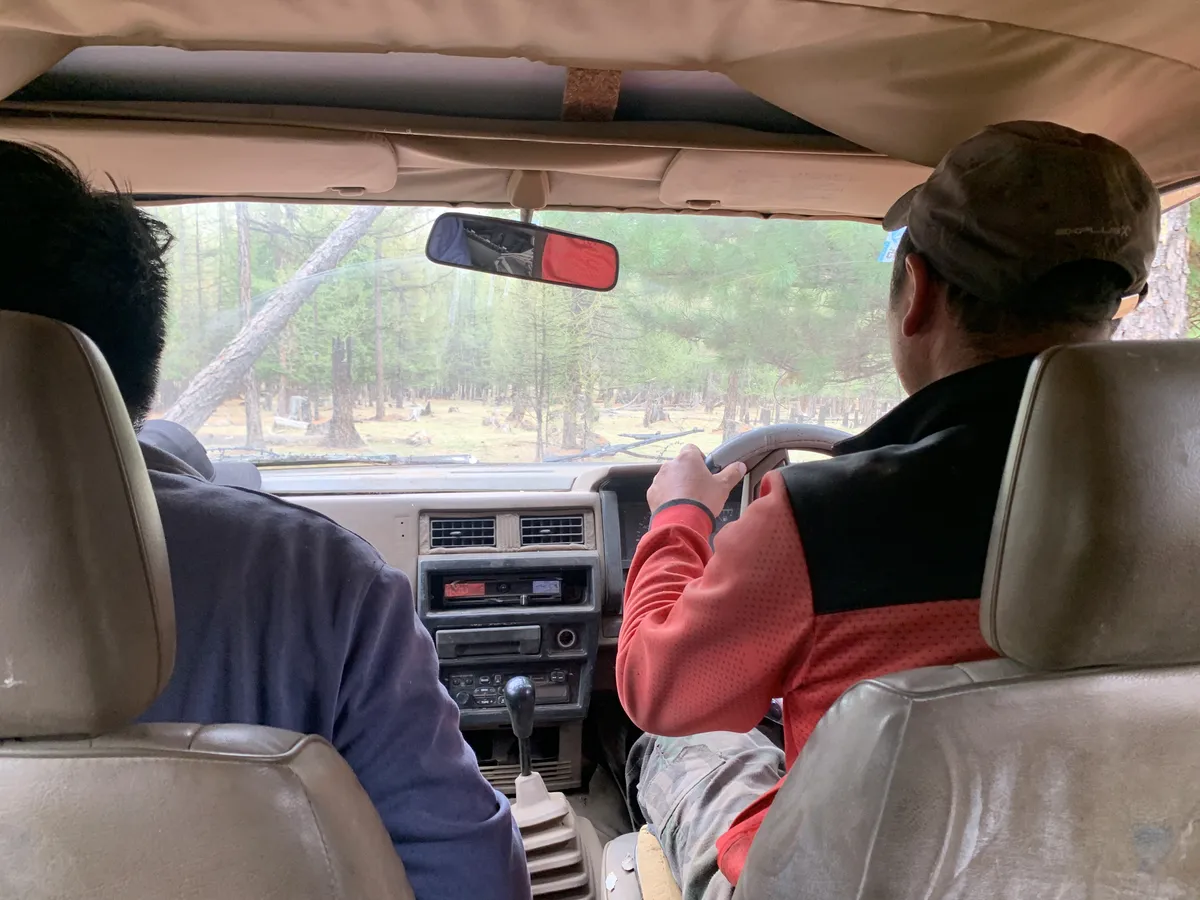 Cruising in our family's truck through a forest looking for wood
We had spent the first 4 nights in the farm ger, having been dropped off there after taking a 8 hour bus from Ulaanbaatar to Bat-Olzii and then being picked up by a host family’s friend (in his "voiture" with 80s music soothing us as we rocked through the endless fields). Arriving at the family's ger didn't feel exactly like arriving in the middle of nowhere, as clearly it was somewhere where peopled lived their lives, but it definitely felt very out there for me.
The family's ger was tiny, with a single bed and a double bed, a fire in the middle, and some dressers, cabinets, and a small wash basin. Our backpacks and bags took up an embarrassing amount of space, making me feel insecure about the amount of stuff I had been lugging around (did I really need running shoes and hiking shoes? Why did I have 3 books?). It’s funny how some people may be like “wow you lived a few months with just that much stuff” when they see my backpack, whereas other cultures may wonder why I have so much stuff.
We were told, on the Worldpackers website, we would work 5 hours a day and have 3 days off. I was a bit naive to think it would happen this way haha because it doesn't seem that much in this rural area follows a strict schedule (and instead just follows the weather and the animals and the vibes of the land). Our one week felt more like work just happening randomly throughout the day, with some things that could be work also not really feeling like work. It wasn’t like “ok you finished your 5 hours now, go have fun” and instead more like “we are going here now” and off we went to do something. The worldpackers posting, on our second reading, hilariously noted that this work exchange had a digital nomad/remote work option. I laughed trying to imagine me doing Zoom meetings with 6 other people in this tiny ger.
The work was mixed between the farm and the tourist camps. We spent our first 3 days doing a mixture of hard-labour as well as riding horses for fun and just laying around. Each day started with shoveling out the goat and sheep poop from their pen at 7am, then followed by breakfast around 8-9ish. It felt nice to do some physical labour before having our first meal. Following our breakfasts, our worked ranged between cutting trees down in a nearby forest (which I questioned internally the legality of), shoveling more shit in other areas, and the herding and catching animals.
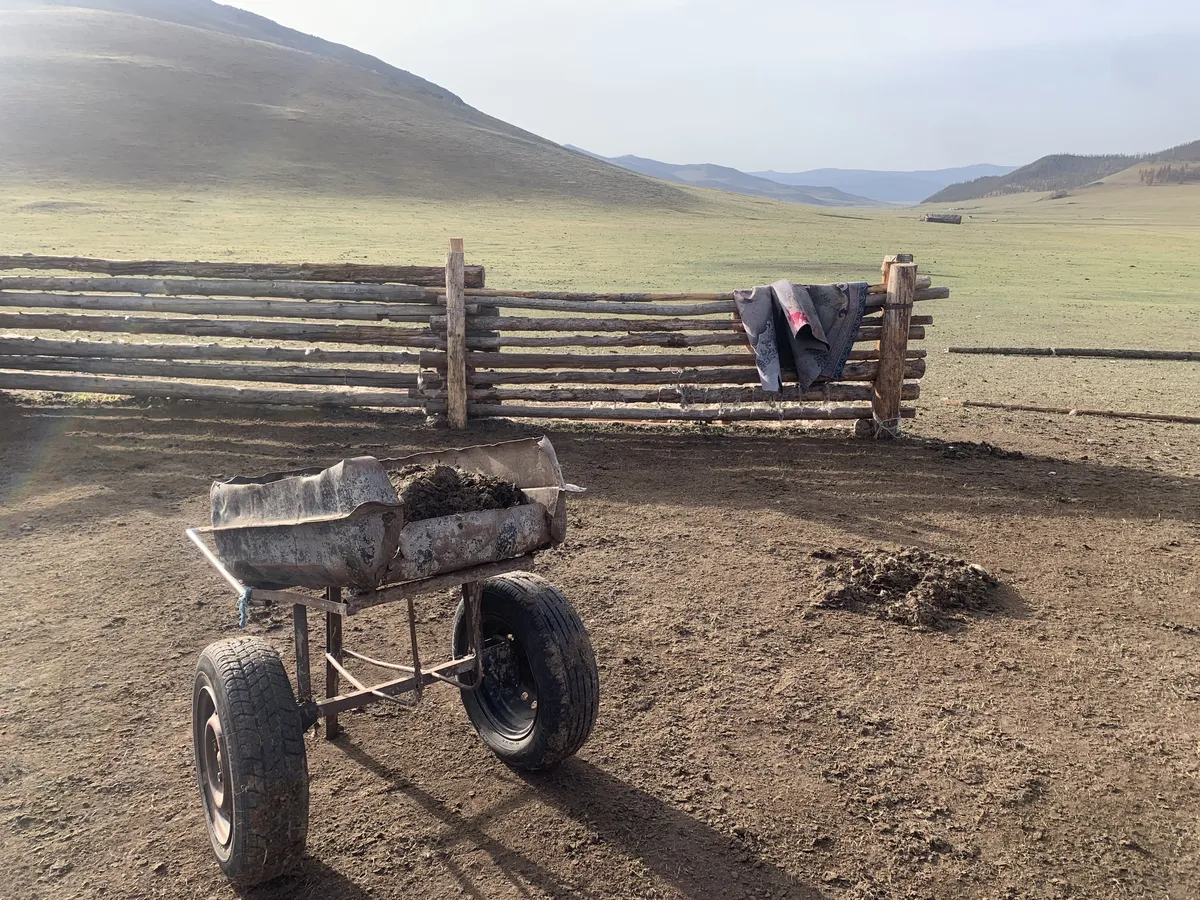 A wheel barrel full of shit with a nice view
My favourite work was herding animals. We got to do this sometimes on horseback, which felt like I was in a movie, while other times was just in person. The family normally just uses motorcycles to herd these days, while I legit saw other families use whatever car or trucks they have.
Our family had horses, sheep, goat, and yak, all of which live semi-wild, roaming the open pastures (e.g. no fences, just nature) during the day and then mostly being herded back to their camp at night. The horses were the most wild, sometimes not coming back for days, and therefore were the hardest to herd. We got to herd the horses once while on horseback and it felt equal parts scary, equal parts exhilarating to being chasing semi-wild horses while on a semi-wild horse myself. As we chased around 15 horses up and down hills, I was constantly wondering if my horse would choose to resist my control and run instead with its brethren (resist!!!), but thankfully he never did (although he definitely didn't like me).
The yak were slightly easier to herd, as they travelled closely in a group and were easy to push along. However, as they approached the pen, they would freak out last minute and resist, sometimes taking 15-20 minutes to finally enclose. The goat and sheep were always coming back each night on their own, so they were the easiest to herd (they practically walked themselves into the pen). One day we had to vaccinate all of the baby sheep, which involved us running around and catching the babies as they jumped, dipped, and slipped from our hands.
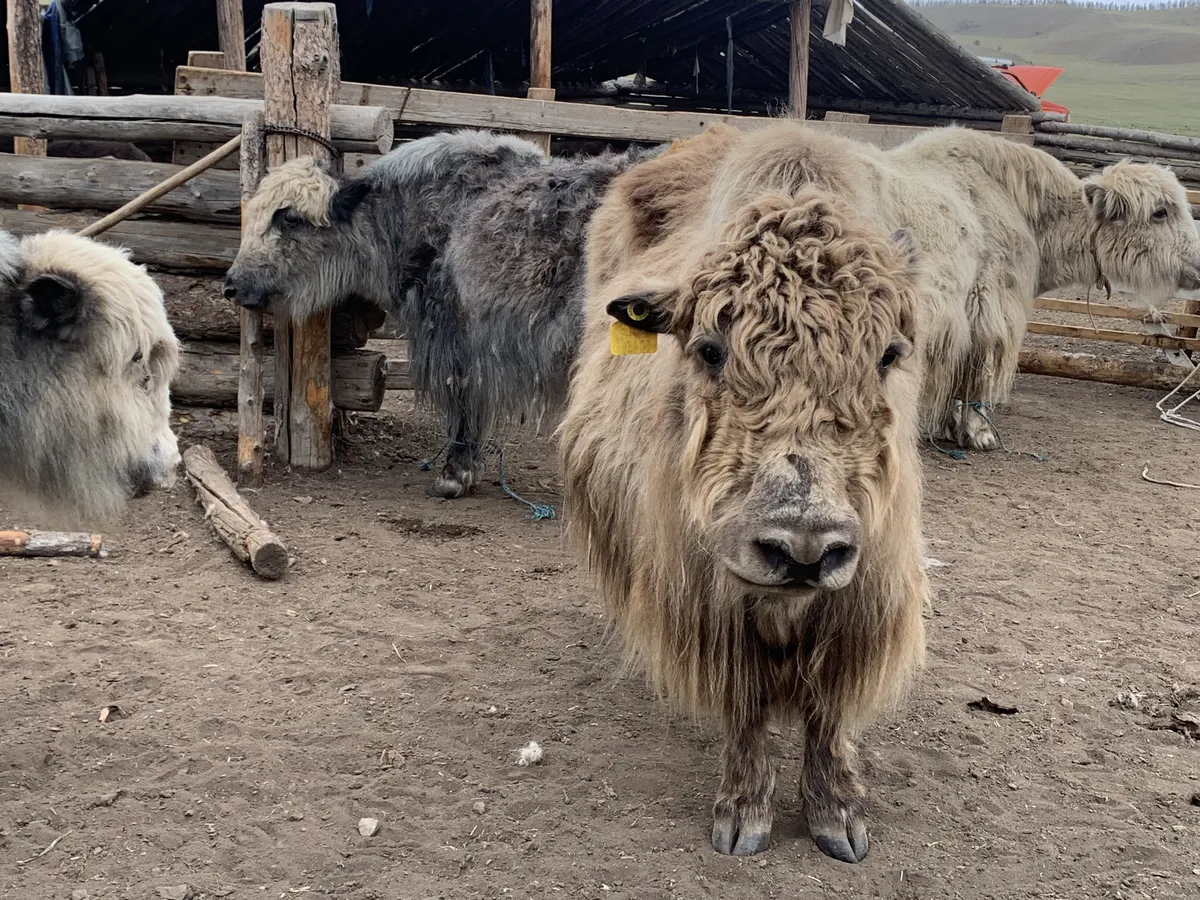 The yaks had pretty neat hairdos!
Setting up gers
On our 4th day, we were tasked with helping set up gers. This involved driving to what felt like 7 locations to pick up parts (while stopping for tea at each place) and then finally unloading everything at what was essentially just an empty field with a shipping container there.
In the span of one day, we all managed to erect and furnish 5 gers, which I was seriously impressed by. It was a very long day, with us starting around 6:30am and then finally finishing by around 7pm in the evening. We were in the direct sunlight all day and it seemed that nobody was drinking any water (just tea and soda randomly). I was definitely feeling dehydrated.
At one point, there must've been around 25 people helping out with this process, with people arriving and going out of nowhere. At one point, some French and Australian tourists even arrived with their tour guides to take part for 10 minutes or so. I imagined that "setting up gers" was part of their tour package and they were promised "an authentic local experience." Photos were taken and off they went.
You set up gers by fist connecting a bunch of rounded wooden fences (which are the walls of the ger). These fences/walls fold up like accordions, so you stretch them out until they meet, while keeping space to add in a decorative door. The fences and door then form a perfect circle, where then two people stand in the middle of and hold up a wooden circle that acts as the top point of the ger's roof. Everyone then gathers round for this part, grabbing these long wooden poles and sliding the poles into the wooden circle being hoisted in the air (it has holes in it designed for the poles). The wooden poles, at their other side, are tied to the wooden fence on the ground with a string, holding together the structure of the roof and essentially the entire building. It's an incredibly simple structure. They then cover the skeleton of the ger in large cotton and tarps, which insulates it from the cold and gives it the classic white yurt look. They then wrap the ger in 2-3 large straps, which act like a belt, and add dirt around the base, and boom - you have a ger!
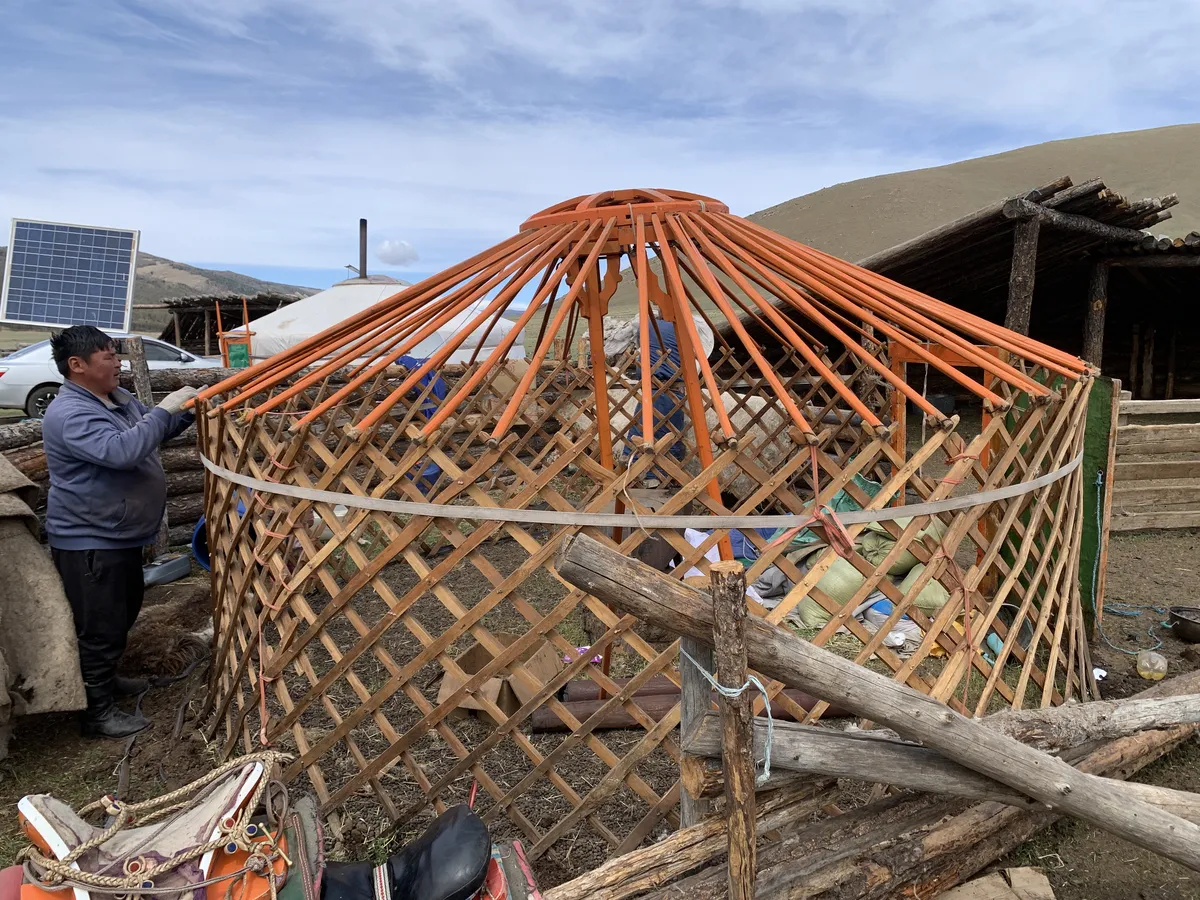 A ger's structure can be seen here. We were actually taking this one apart for parts
It took us about an 1-1.5 hours to do the first ger but I swear the last one was only 15-20 minutes based on how fast everyone was moving. It was interesting as it was mostly men doing the outside of the ger and once we had the outside complete, it was the women mostly who added in the laminate flooring and hung up the carpets/fabric that lined the walls. Since we were building tourists gers, we also added in a bunch of IKEA bed frames with mattresses (most other gers we saw didn't have actual mattresses).
The bathroom for the entire camp was a hole in the ground (a very deep hole!) that then had 3 wooden walls added around it. The only washing station for your hands was in the family's ger, but thankfully in Mongolia it is not weird to walk into another ger unannounced so we could just wash our hands whenever we wanted. I showered myself one day in the river nearby, but aside from that I did not shower all week. It's interesting how in the city (where I just work on my laptop) we shower every day but how other people (who work on the land with animals) can go an entire week without showering. However, when you think on it, I guess working on the land with animals can actually be cleaner than being in the city with our pollution.
Eating as a family
We ate all of our meals together, usually eating 3 meals a day with sometimes a break for fresh yoghurt or for tea. The yoghurt was sooooo good. Our diet mostly consisted of meat, dairy, and flour, with the milk coming from the family's yaks and the meat coming from their goats.
Breakfast each day usually was bread (which came from a supermarket for this family) with handmade urum (also öröm) being spread on it with jam. Urum is this creamy traditional butter/spread that comes from slowly boiling milk (it's the cream that rising to the top). It's quite delicious, easily stays fresh, and is quite filling. Along with bread, we would have yalk milk tea. We added our instant coffee to the milk tea, which created this salty, milky, instant coffee that tasted great in the moment but which I imagine I will never have again (and I'm OK with that). We also somedays had fried eggs somedays.
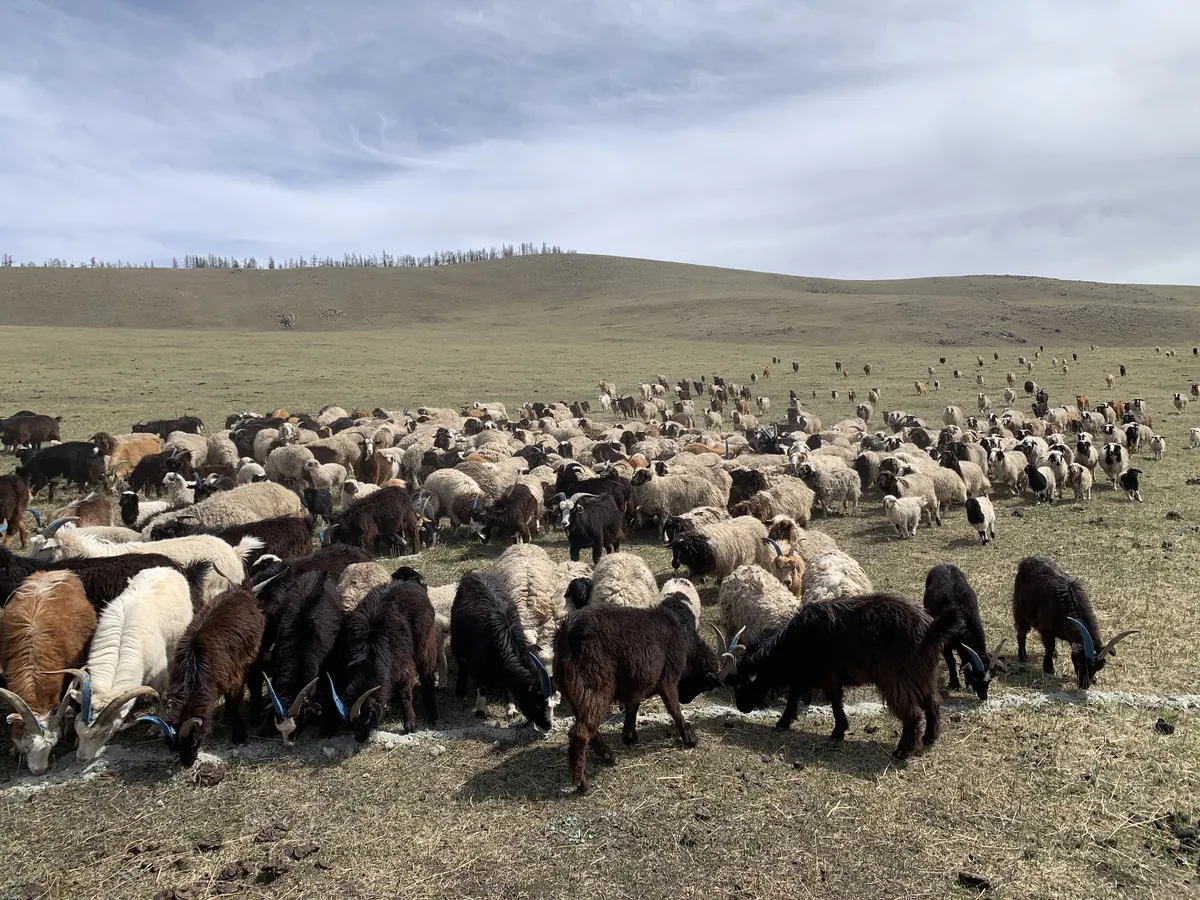 Just a few goats and sheep to chose from for dinner
Lunch and dinner usually ranged between boiled noodles that are stir fried with meat, potatoes (called Tsuivan), large steamed Mongolian dumplings (called Buuz), or a meat-broth soup with sheep meat chunks, fat from sheep tails, potatoes, and noodles (I think it is called Guriltai Shöl). It was essentially just Tsuivan and Guriltai Shöl, as I think we had Buuz twice. There wasn't a lot of rice eaten but we did have it a few times and I savoured those moments. The noodles were mostly boughten from town but we did also have handmade noodles too.
While the ingredients were mostly local (meat and dairy was legit from their livestock) and strong in their natural flavours, I became bored pretty quickly of these meals. I think eating any meal every day can be boring, but I also just craved for any types of other flavours or spices. Living in a city in the modern world, food to me has become a thing to be enjoyed, not just a thing needed to be consumed to survive. Living with this family, while I can tell they enjoyed their meals, it also seems that they were just content with eating the same meals constantly, the same way that I am fine with using the same toothpaste flavour endlessly. (It's not that I hate my toothpaste, but I don't really seek pleasure from it.) Maybe I'm projecting here too much though as this was just one week with this family and perhaps as the seasons change they get more and more variety in their diets and their pleasure of eating, but I feel that maybe this is just what diets are like when being a nomadic, rural family.
The arrival of guests
Our last night with this family saw the arrival of their first guests. It was interesting to see how we were fed different meals when they arrived, as we ate chicken and mushrooms for dinner that night (first time seeing each ingredient all week) and a salad with spam and eggs for breakfast (I guess this was more "western" lol?).
We found out these guests were paying some tour company $200 USD a DAY for their horse tour, which would involved being taken out by our family to see the nearby lakes on horseback. We had previously asked the family if we could do a similar tour, which they said would charge us $50 USD a day for... while maybe they were giving us a family-friendly price, that difference is still very massive. It's a good reminder that if you can arrange tours directly with horse guides and nomadic families, you will save a lot.
That's all for now :)
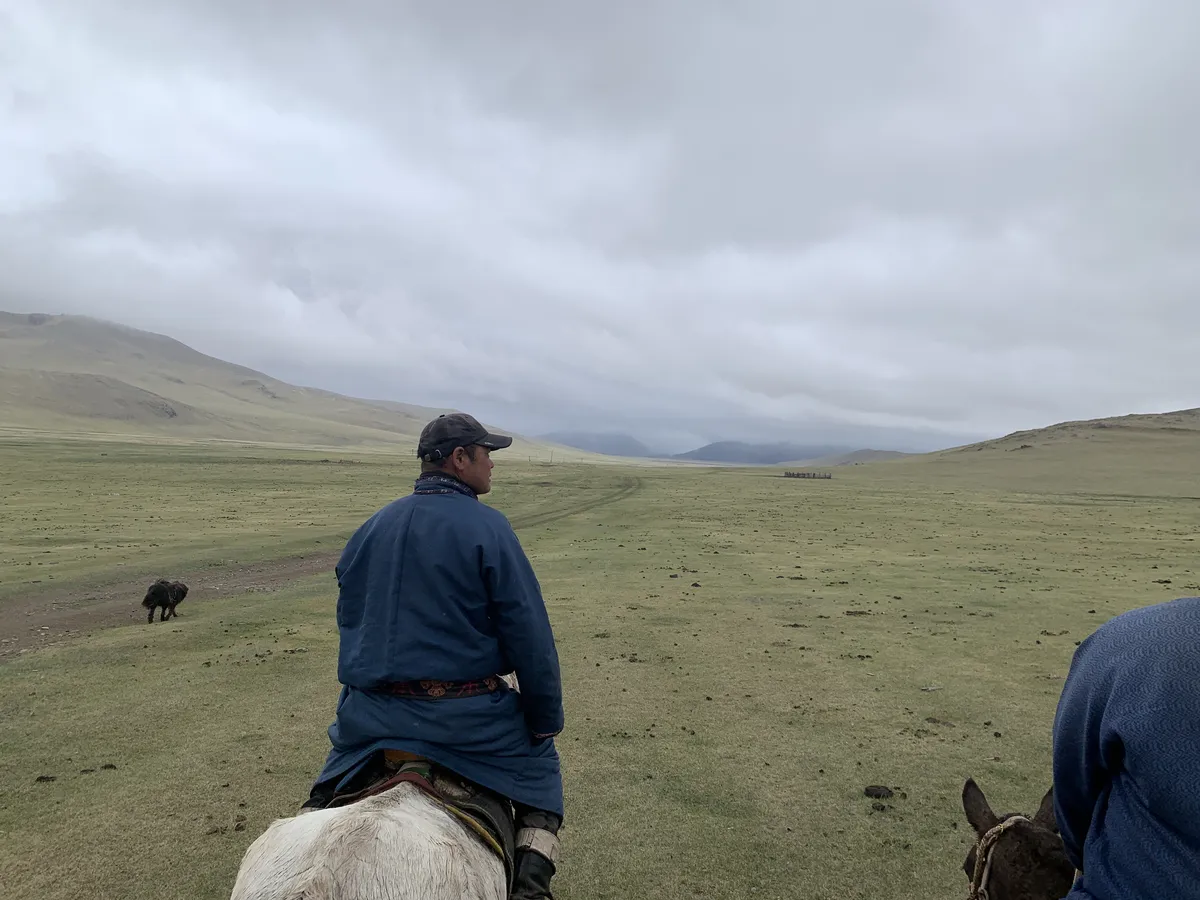 Our host father is shown here as we rode horses one afternoon through Orkhon Valley