Mongolian Work Exchange 1: the Outskirts of Ulaanbaatar
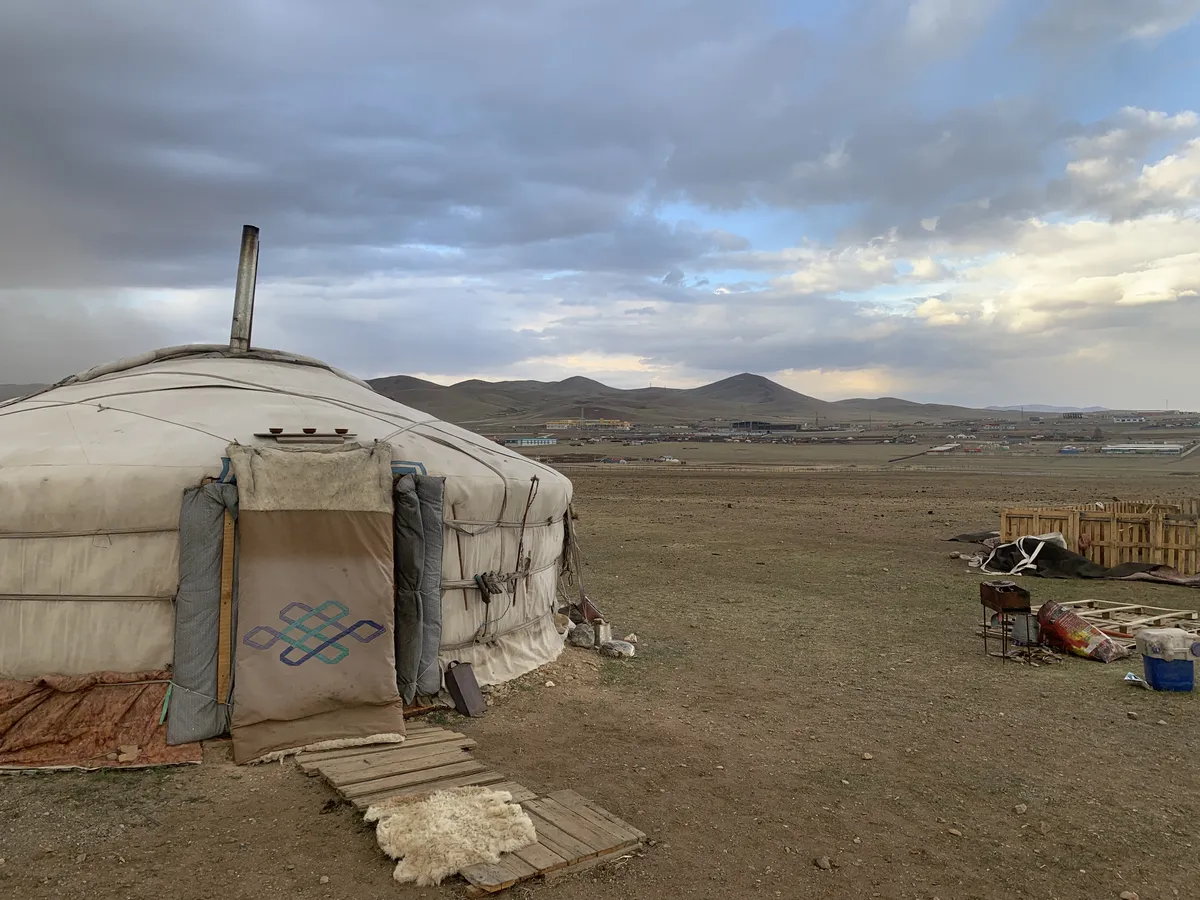 View of the ger I stayed in for this exchange.
I recently just completed two work exchanges in Mongolia and would like to share some reflections from the experiences. This post is the first experience
Introduction to work exchanges in Mongolia
For those who don’t know, a work exchange is simply when you do some hours of labour each day in exchange for usually food and accommodation (although each experience is different). You can arrange them through a plethora of online websites and apps (such as WOOFing, Workaway, Worldpackers, etc), or just by messaging hostels or other places that have plenty of tourism or need seasonal work help (like farms).
I have some experience with doing work exchanges, having done them before in Portugal, Switzerland, Ireland, and Canada using the websites WOOFing and Workaway. I see work exchanges as a way to travel cheaply in more expensive places, to be able to stay in places where there are not any accommodations available (such as rural areas), and, usually most importantly, to immerse yourself into the local culture more deeply than you would simply travelling.
For Mongolia, before arriving, I thought travelling around would be cheap, so I was unsure about doing a work exchange there. However, upon further review, travelling Mongolia (and having a more authentic visit) proved to be a little pricey actually... It seems that a lot of tourists, even those at backpacker hostels, tend to explore the great steppes, deserts, and mountains of this country by organized tours, which can be ghastly overpriced and a bit sanitized for the needs and tastes of tourists (giving you different food than locals, different beds, etc). For these reasons, I am happy that my partner had pushed for trying some work exchanges and this is how I got to stay with two families in work exchange agreements.
Finding the experience
My partner and I found our first work exchange via Workaway. You need to pay for annual subscription for Workaway, but I already had account from doing an exchange in Quebec the summer before. There weren’t a lot of Workaway options in Mongolia, but after messaging a few folks we agreed to go spend just 2 nights and 3 days with a couple just on the outskirts of UB.
From the beginning, it seemed that this wouldn’t be a traditional work exchange...First, they said we could only stay 2 nights, whereas most work exchanges are at least one week minimum. Second, they asked us to pay $77 CDN for our two nights together to help cover the costs of groceries, which is very high for Mongolia. However, their reviews seemed great and we had another longer work exchange lined up so we thought this would be a nice low-commitment introduction to Mongolian culture and agreed to visit them. I'm glad we did.
After spending 2 nights in UB, we took the public bus to the east of the city, switching buses once at a random stop as explained by our hosts. Google Maps did not have any public transit options for this route, but I can definitely confirm that public transit exists for this route. Buses come pretty often it seems in UB and are very affordable (only 40 cents or so in CDN $). It felt nice to be outside the knowledge of Google and back into the world of asking people for directions.
After an hour or so on our buses, we arrived at a gas station bus stop. The area felt not quite suburban, but definitely not rural, as there were plenty of development in the area, although not like anything I was used to. To paint the scene, picture a 2-lane divided highway with roadside shops and service stations similar to any major highways in North America, but then just behind these shops on both sides you see rolling fields that were full of houses, yurts, roaming animals, factories, and sadly waste blowing in the wind, with small mountain-like hills in the distance. It was beautiful, vast, and strange.
On our walk from the bus stop through random fields to our host’s house, we passed by houses, fences, a broken down bus, some cattle, lots of animal poop, and a dried out agricultural field. Our host was FaceTiming us as we walked through this all, which we found as a funny way to give directions but it worked!
Upon arriving, our hosts, who are named Begzsuren (Bee) and Mungunsoyombo (Soy), welcomed us their yurt home. (Yurts are called gers in Mongolia and have a deep cultural connection to Mongolian society). As is custom in Mongolia, we quickly had some tea together. The tea was a salty milk tea, which is very common in Mongolia and honestly a flavour I am not the biggest fan of. I of course said I enjoyed it (as I would say many times for the next month) and Bee and Soy were friendly and full of smiles.
Bee and Soy have their ger on a shared communal land, which was complicated to understand at first. It seems that the government owns the land, but had agreed to provide the land to this Korean doctor/researcher 30 years ago or so in an effort to study solutions for growing more vegetables in Mongolia. (The weather in Mongolia isn’t the most prone to vegetables, so it seems most farmland is used for grazing of animals rather than vegetables, which can be seen in the traditional meat and diary diets of most Mongolians). This Korean doctor, who was named Mr.Lee, then provided a portion of this land to a group of Mongolians who run a cultural retreat space, of which Bee and Soy contribute to and where they also live. (More on Mr.Lee in a bit...).
A side note: private landownership in Mongolia is a relatively recent concept, only coming into major usage in the 1990s. This is due to the country's history as a communist country where all land was government owned. At a museum visit in UB, an exhibit proudly noted that, by the early 2000s, a majority of apartments in Mongolia had finally become privately owned. I found this funny because in Toronto we are actively fighting to have less apartments privately owned.
Anywho, on the day of arrival, Bee was helping the cultural centre host a day-trip for students from a private Chinese-Mongolian primary school in UB. We arrived to the sounds and the sight of a hundred or so children running around and screaming, which instantly made me question what we had got ourselves into. However, once we got to sit down with some of the students, we ended up having a great time.
With the students, we were taught some traditional Mongolian games, with the majority of them involving sheep knuckle bones (which are about the size of a school eraser). The most common game involves "horse racing," which is where you roll the sheep bones as if they are dice and depending on which way they land you get to move forward or backwards. An easier game for me to understand just involved bending your arm upwards (so your elbow is facing out in front of you) and then you place a sheep bone on your elbow and flick your arm forward while trying to catch the bone. It’s actually quite hard!
The students shared a bunch of their snacks with us and told us all about their lives. Some of the students spoke English impressively well, with one student being fluent in English (having grown up earlier abroad). They were only around 8-10 years old but they spoke like adults, being both comical and serious in their reflections on Mongolian life (although one of them did yell “hey! 6-777777!” and run away).
After the students left, the next 1.5 days were calm, with us hanging around with our hosts. We stayed with Bee and Soy in their ger, sleeping on their floor and sharing in their meals. Their ger was a 5 walled ger, meaning the circular base of the yurt has 5 walls that you connect together. The number of walls is how you describe the size of a ger apparently.
For those who have never been in a ger, it is kind of like a circular studio apartment meets a winter cabin. The centre of the ger is a fireplace, that doubles as both a heat source and a stovetop. There is then usually a hand washing station near the front door (which I found all look identical), followed by 1-2 beds and a bunch of cabinets/shelves. Some gers have modern amenities like a washing machine or a fridge, but none I saw ever had bathrooms inside or running water. Bee & Soy had access to a shared washroom in the cultural centre, which was a nice luxury for us (still just a hole in the ground, but a nice hole).
During our short time together, Bee and Soy opened up about their lives to us, as well as about their history of hosting tourists. As it turns out, they are quite experienced with hosting strangers, with my partner and I being their 791st group hosted. It's always great to feel like a number.
They said they started hosting back in 2008, beginning with Couchsurfing. Based on my math, they have since been hosting around 100 guests a year, which is around 3 a week given the lack of guests during early Covid years, as well as during the cold winter months. They said their goal is to get to 1000 guests, so they are getting close. They count visitors for their afternoon cooking classes, which are booked on Travelling Spoon, as guests “hosted.” They also find visitors from Workaway, Warmshower (for bikes), and Trustroots (for hitchhikers). So many sites to monitor!
Just to be nosey, but if they are charging $77 CDN each visit, and they have around 100 visits a year, then that brings in around $7700 CDN a year. However, I see their cooking classes actually cost $316 CDN, so maybe that annual number is closer to $10k. If the average salary in UB is around $13k a year, then what their earning is not a huge amount of money but it definitely helps with their bills (while allowing them to meet others).
See Bee & Soy's Workaway account: here
See Bee's English website: here
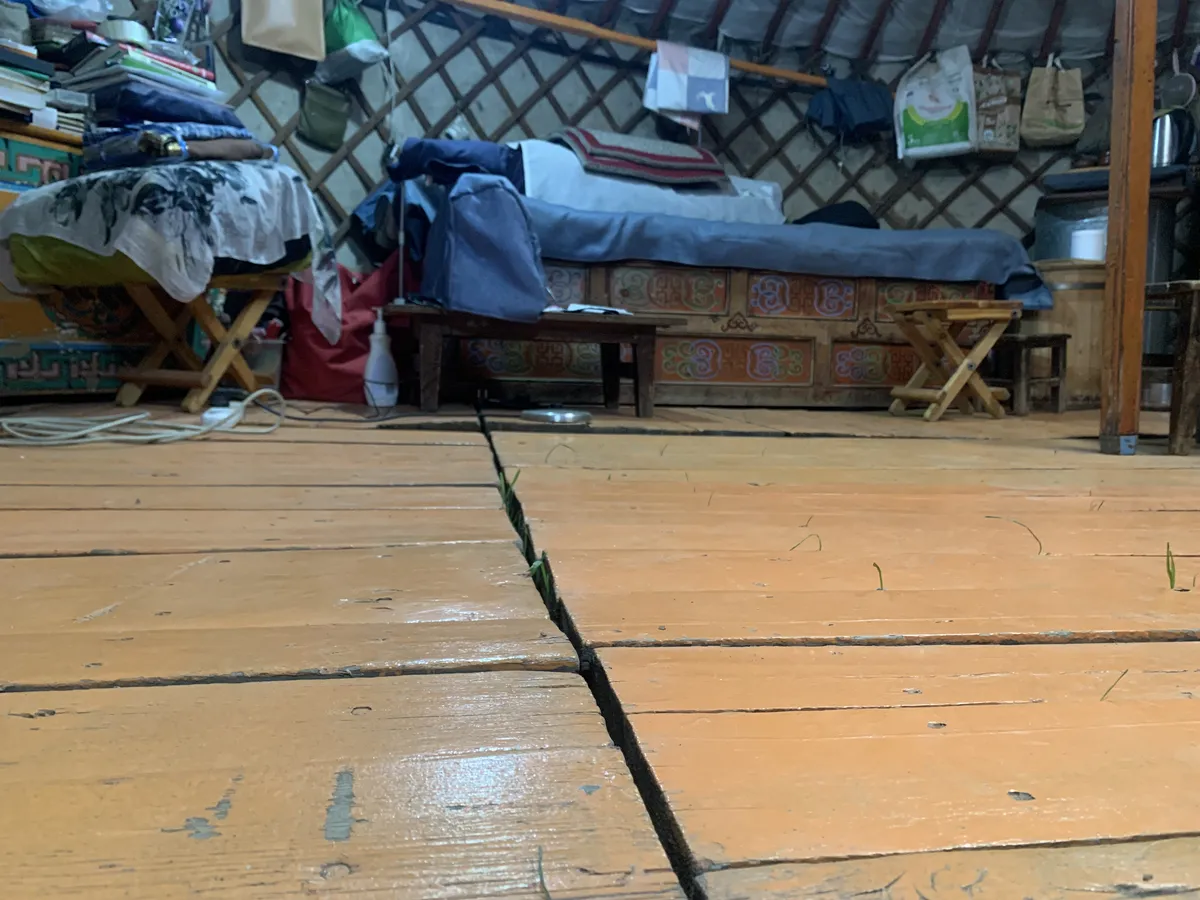 view from the floor of the ger, with some grass sneaking on through
Mongolian Customs?
During our time with Bee and Soy, we were informed of some customs for living in a ger (and just being with Mongolians in general). They were:
- You can wear shoes in the ger, but just not in your bed. This was a shock to me after coming from China where bringing outside shoes inside any house is a big no-no.
- If you are take of your hat, you are to hang it up on the ceiling of the ger. You can also hang your towel and seaters like this. (The ceiling's structure is made up of a bunch of wood poles that meet in the middle like spokes on a bicycle wheel)
- When you enter a ger, you should enter counter-clockwise (or in the direction away from the host’s bed). You should avoid sitting or being near their bed, as its like entering their room.
- They use fork and spoons when eating, not chopsticks. I guess that sounds obvious but I just dumbly assumed that being so close to China would influence this. They also eat a lot from bowls and will just slurp directly from the bowl, rather than using cutlery.
- When holding a bowl, try to not hold it with your fingers inside it.
- You shouldn’t squat if you are resting (like they do in China and many other countries) as they see this as being impatient. It’s better to sit on your butt on the ground or with one knee up.
- The man of the house is served his meal first, followed by the guests (with the older male guest getting his food first). We were informed this is not about gender but about having order in the world. This order made me uncomfortable (is the patriarchy just order to some people?)
- It’s not seen as rude to lick your bowl! Instead, it's a very normal gesture that they requested we do (in order to clean the bowl). Bee had 10 reasons for why you should lick your bowl, ranging from cleanliness to tongue strength to having more saliva breakdown your meals.
- Growing your hair long is a normal custom for both genders and is a way to connect yourself to the land.
- They also spoke a lot about energy, linking this to the reasoning for many customs, as well as dietary decisions. While I didn’t always agree with the emphasis on energy, most of the things they said did make sense and it is nice to focus more simply on reasonings for living well and simply.
For their customs, Bee and Soy were very adamant on seeing them practiced by us, but I later noticed some of these customs not being followed in our gers I visited across the country. I am therefore unsure how much of these traditional customs are still followed by regular Mongolians vs how much was this being a bit more intellectual in Bee & Soy's pursuits of traditions. For example, when I asked our my other host family if we should like our bowls after eating a meal with them, they said, while laughing, “No! That’s like a dog! Only for yoghurt.” Regardless, I admire Bee & Soy's desire to preserve culture, even if modern Mongolians are moving on.
Mongolian Local Food
Our food with Bee and Soy was mostly dairy and meat. We ate a lot of cow dairy, ranging from boiled yogurt (tarag) to dried yogurt (aaruul) to a few Mongolian cheeses (much less aged or strong than European cheeses). They make all of their dairy products themselves when their cows produce milk, or when they buy milk from the local market in UB.
I was amazed at the amount of food you can make from dairy. It also sounds really dumb but I never realized that cows only produce milk when their babies/calves are breastfeeding. I guess I just thought that they always produce milk? How wrong I was.
They had 4 adult cows and 4 calves on their property, with 2 of them being pregnant and 2 having older calves, so there wasn’t any milk production happening. We found out that they don’t eat calves (e.g. veal) here but that they do kill the male cows after 2-3 years (and eat them). They informed us that selling animals is a major source of revenue for many Mongolian families. While having a dozen or so cows can produce enough dairy products for just one family, such as the yoghurt we ate, selling a cow can provide hundreds of dollars.
I was surprised to learn they don’t eat much meat in the summer and that Bee and Soy were actually vegetarians for a few years earlier in life. After spending a month in Mongolia, I find this even more surprising given the deep, deep integration of meat in diets and lives here, so kudos to Bee and Soy on that!! In our mornings, we drank our own coffee (instant coffee...which I have now accepted as a possible form of coffee while travelling) in the mornings and ate apples we packed too - we were informed this mixture wasn’t good for our energy (!!!) but it tasted good to me.
Our work on the farm (and urban planning thoughts)
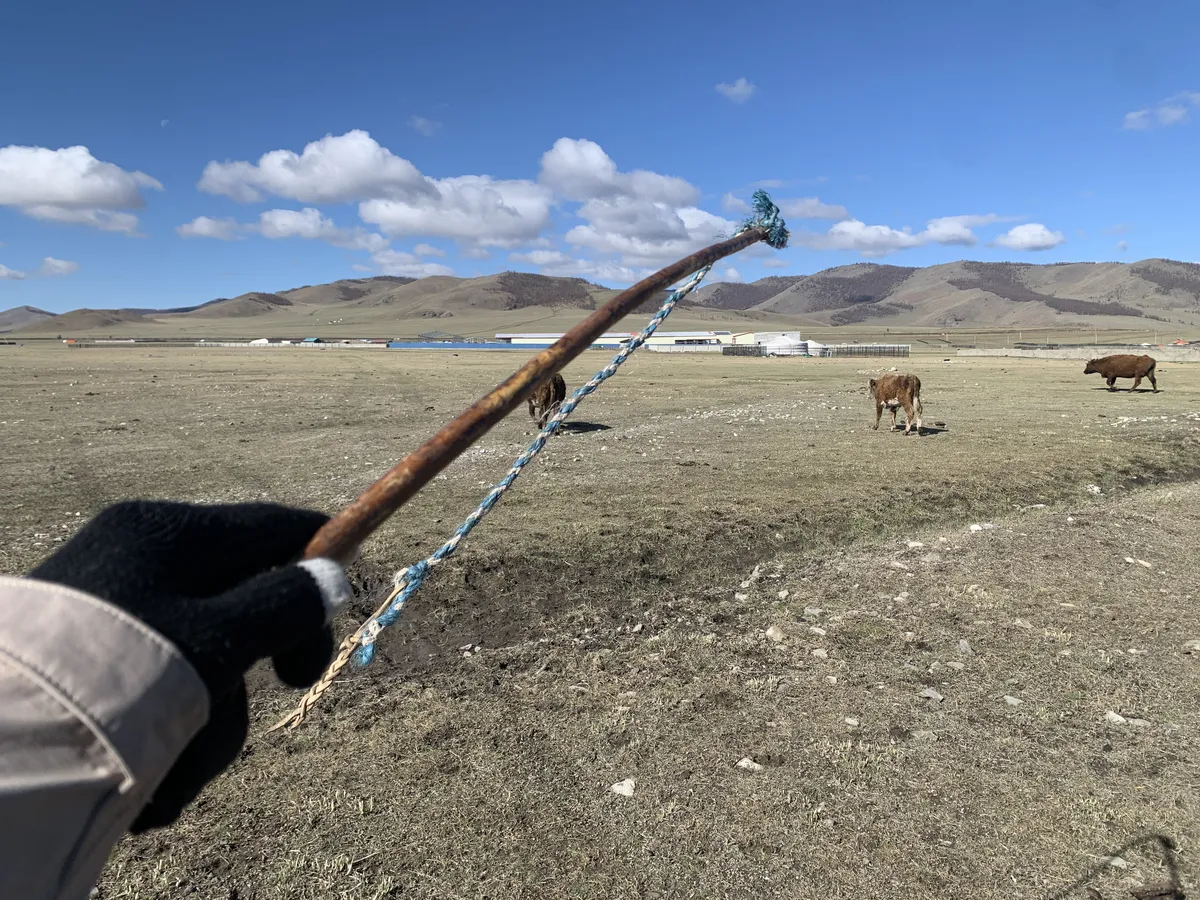
During our working hours, we were able to herd the cows from next to their ger to the rolling pastures about 0.5km away. We used little sticks tied with a plastic string and a leather tip to direct the cows forward, while yelling “Hoooch!” We did this in the morning before breakfast and then again before sunset, bringing them back home. (I now also understand the phrase "till the cows come home"). It’s amazing how such massive creatures can be so docile to humans and directed by legit just a piece of string on a stick.
On our walk through the neighbourhood, you quickly notice that urban planning in this area has been uninterested in separating uses, as well as needing road networks before allowing for development. The result is a slightly chaotic vibe, but one that also feels like the early blue prints of what will become a suburb one day. The fields surrounding their property are full of smaller square parcels of lands, each about the size of one to four basketball courts, which are sometimes fenced off using variety of materials and styles (cement, wood, metal, or plastic fences, but sometimes just painted car tires dug into the ground to delineate boundaries). Each parcel of land seems like it was placed haphazardly, with no formal roads connecting them and therefore making navigating around them a little disorientating. However, there are electrical wires servicing a good chunk of this area, which results in a electrical grid and therefore some orderly lines. There weren't any running water or pipes for human waste on these lots, which we noticed were both things you don't see much outside of the downtown of UB.
The small parcels of land, we were informed, are mostly for 2nd homes for people from UB. Either these are folks who come in the summer, set up their ger, and live outside of the hustle and bustle of the city, or they are for families who will one day move out here but for now continue to live in the city for work. In and around the small parcels of land though were some larger factories and businesses, creating this strange feeling of industrial meets urban sprawl meets farmland (as cows and goats and horses roam on their own). The factories could be loud and produced a lot of waste, making me feel curious why someone would want to set up a ger next to it. If I'm going to live with no running water or toilet, I feel like I would prefer to at least have a bit more nature.
However, I guess this spot does have the luxury of electricity, the ability to be back in UB in an hour or so (even by bus), while still being able to have your own animals, so I can see the allure (although Bee informed us that in a few years this area will no longer allow animal herding due to changes in UB's zoning - can't escape zoning!).
Aside from herding cows, we spent our time picking up garbage, helping take down a fence, and picking up a bunch of cow poop. I was amazed to learn that they heat their gers by burning dried horse poop. They said this was good for energy and provided anti-bacterial qualities. While I’m unsure if I buy into those reasons, I still think this is a really cost-efficient and sustainable way to heat a home. I’m surprised I hadn’t seen this before (such a sheltered city life I live).
Saying Goodbye
At the end of visit, we added our names to Bee and Soy's growing library of guestbooks. It was cool to see names going back from 2008, as well as witness their ability to remember the stories of these early guests. I wondered if they felt a special connection to their earlier guests in 2008 and whether their guests today (aka me) were more just just numbers now? Would they remember us in in 18 years? I seriously doubt it haha.
In our goodbye, we answered some questions on camera about our experience. It's funny how any camera, even just a random cellphone, can make you instantly feel awkward. Bee said they were going to compile a massive video for when they hit 1000 guests and have a large party. At this rate, that would likely be in 2028-2029. I don't think I will be back in Mongolia that soon but who knows in this world.
The side trip with the Korean Doctor, Mr.Lee
During our time at the ger, we befriended the Korean doctor who was researching how to grow Korean vegetables in Mongolia. Mr.Lee was an interesting character, and while not really related to the workaway, I wanted to write about him.
Originally from Seoul, Mr. Lee spent time in Australia, UAE, and Denmark before then spending 3 decades in UB trying to promote vegetable agriculture to local Mongolians. Now in his early 70s, he acknowledged that his intensity in work and amount of projects had decreased (since he was technically retired), but that he was still searching for innovations and exploring ways to use greenhouses more efficiently in Mongolia. He noted how he mostly works now on his own time and dollar, rather than getting large grant from the Korean or Mongolian governments, but we did meet a delegation of 5 Korean government workers while we were there so who knows what's going on.
After being invited for an afternoon coffee with Mr. Lee at his home on the farm, he informed us he was a devote Christian, which gave his agricultural promotional work a bit of a missionary lens. We even wondered if maybe all of this agri-work was a front for being a missionary haha, yet his rows of awards and plaques for his agricultural work subdued that thought (slightly). He wasn't the only Christian missionary I met either... So many people trying to save these poor, poor Mongolians from their sick Buddhist fates!
I still wonder, though, why the Korean government would be interested in supporting agricultural work in Mongolia. It feels a bit colonial to push your agricultural practices onto another country, but I will acknowledge that after spending a month in Mongolia that I deeply missed vegetables in my life and that with Climate Change that there may be more room (and need) for alternative agricutural options in Mongolia. It also seems that maybe Mongolia could be a new frontier for agricultural production for Koreans too, as Korea is a much much more dense country that is tight for space and in labour.
After an enjoyable coffee together, Mr. Lee invited us to stay in his house many times instead of staying in the tiny ger. He had a 5 bedroom house, with 4 bedrooms being vacant, so there was plenty of room for us to crash (his wife and son lived in Seoul, which he said he visited 4-5 times a year, although he didn't seem intent on living there even in retirement). However, we were enjoying our time with Bee and Soy, and I also felt uncomfortable changing our plans, so we politely declined his requests each time he asked. Finally in lieu of staying over, he offered to take us to the nearby national park the next day. We agreed to that, so at 10am the next day our bags were loaded into his friend’s Toyota Prius and off we went.
Our trip to the national park ended up being a bit of a drive around and take photos of monuments, interesting rock formations, and of the Genghis Khan, also known as Chinggis Khan, statue nearby. In the car, was myself, my partner, Mr.Lee, a friend of his behind the wheel, and this random younger woman in the backseat who didn’t speak much, nor got out the car for the destinations. The all felt like characters in a movie that don’t speak any lines, but are not exactly background characters either. In a way, I felt like a background character too. I'm unsure who the main character was here though as no one seemed overtly thrilled on this trip, feeling as if we had to all drive through these sites before getting home. In the end, I don't know what to think.
Side note: I met other travelers who ventured, either on their own or in paid tours, to just visit the massive Genghis Khan statue and I honestly don’t understand why. Yeah it’s big, but its honestly just a statue. After 5-10 minutes, you’re likely bored and then you then had to commute another hour or two back into city.
Thanks for reading.
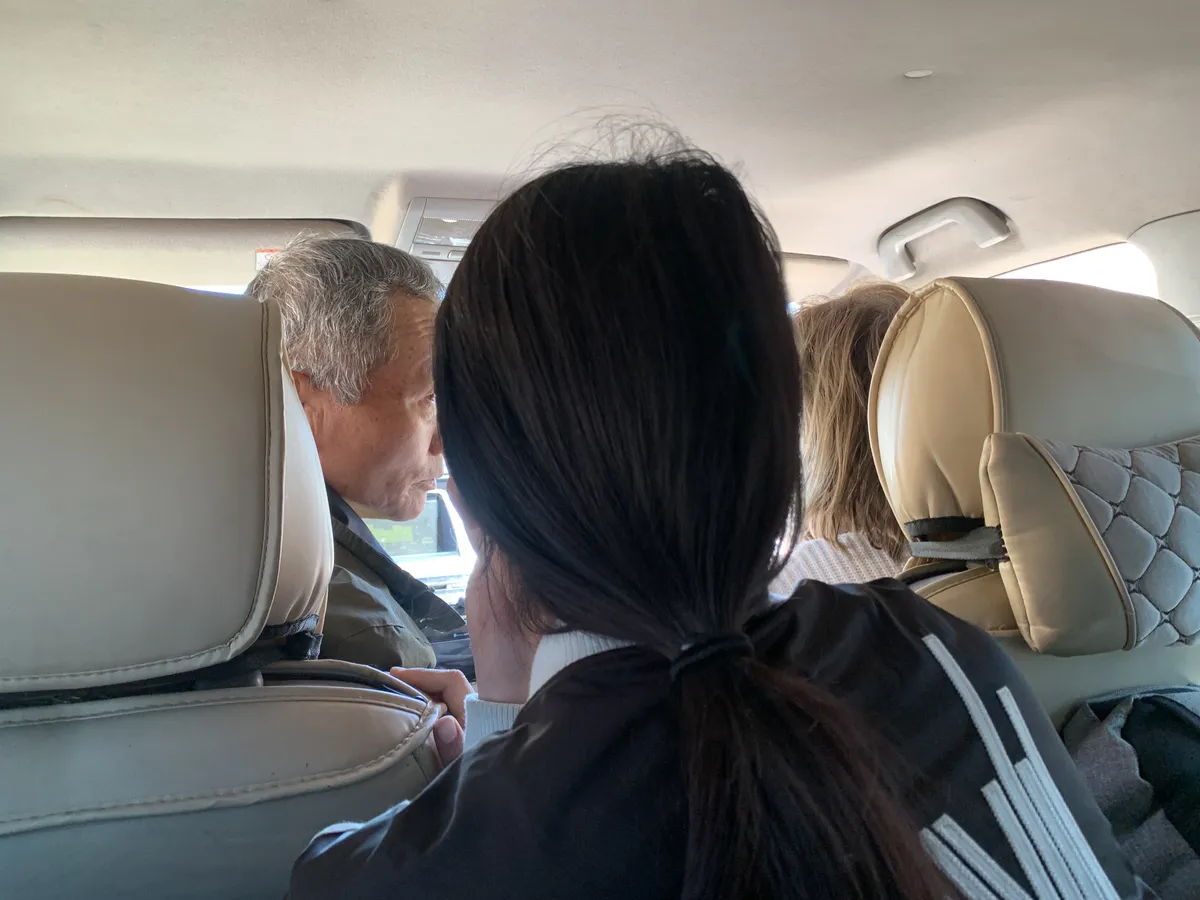 view from the backseat of the car on our tour.