One Month in Mongolia
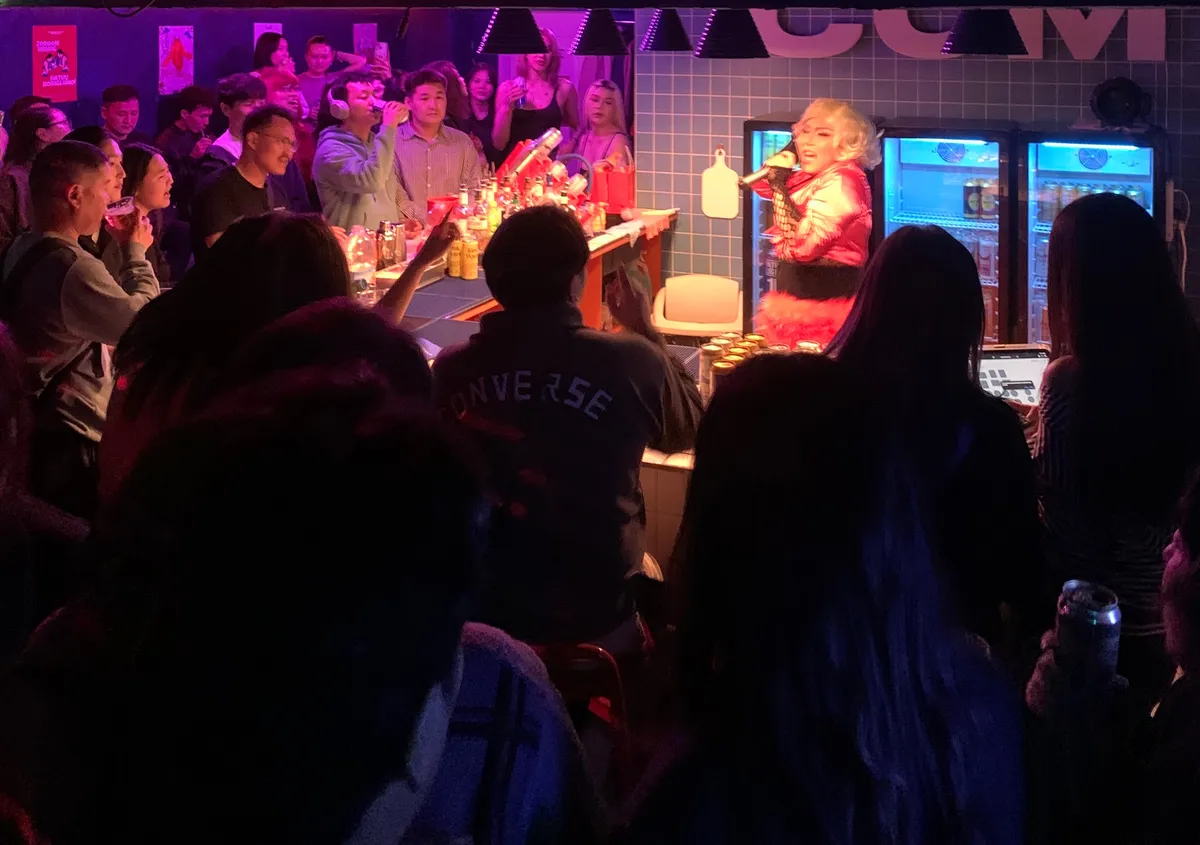 View from a drag show at UB's C.U.M Bar
I just spent a month travelling around Mongolia and I’d like to share my experience for those who are curious.
Overall, it's a beautifully vast country that is deeply connected to the land (and to its own history). It’s sparsely populated, (I think the least dense in the world), offering plenty of escapes into nature and more rugged forms of travelling.
Introduction to traveling Mongolia
I travelled to Mongolia in May 2026 as part of a 5 month trip in Europe and Asia. I travelled the country with my partner while meeting some other travellers and locals along the way. As a Canadian, I can visit Mongolia visa-free for one month, so I stayed for the entire month (minus a day).
Most people arrive in Mongolia by plane, landing in the capital, Ulaanbaatar (UB). I saw there are direct flights to UB from Seoul, Frankfurt, Istanbul, and Beijing, so I imagine most travellers take routes through these cities to arrive. You can also arrive by train, which is what I chose to do, coming from Beijing by train. I shared my thoughts on that experience here. I also met other travellers who planned to exit the country by bus into China, which would be fun to try.
Most people travel Mongolia in June-August due to cold temperatures during the rest of the year, but we chose May because it just happened to work best for our schedules (and it would still be warm enough to do most activities while being less busy). During our month, it did happen to snow on us a few times while we were in the central and northern parts of the country, but thankfully I had brought my winter gear (toque, gloves, scarf, puffer jacket, etc) so this wasn’t too bad (still cold though!). Most places were open already too, but we did see many hostels and guesthouses still building their yurts for the season.
Organized tour or DIY for Mongolia?
For Mongolia, I thought travelling around would be cheap but it prove to be pricey in some ways. It seems that a lot of tourists, even those at backpacker hostels, tend to explore the great steppes, deserts, and mountains of this country by organized tours, which seem ghastly overpriced.
Most tours I saw were around $165 CDN a day, while I met two people who were paying more than $250 CDN a day... While these tours usually include all of your costs (food, accommodation, transit/driver, a English speaking guide), I think these prices don’t really reflect the quality of what you receive. I honestly think tour groups just make up prices and see what sticks. For example, in UB, to eat out you are likely to spend around $8-10 CDN on a meal, which gets you a good meal. A hostel bed is around $20 CDN a day. The local bus costs less than 50 cents CDN and regional bus trips are around $15-30 CDN to cross the country.
Costs get even cheaper as you leave the city, so you are essentially paying a massive premium for someone else to just plan your trip for you. This is totally fine - as this is what travel agents are for - but I guess I was just surprised at the amount of backpackers that instantly went with organized tours in Mongolia when on the rest of their travels they would scoff at the idea of using a travel agent. Knowing all of this, I am very happy that my partner encouraged us to travel Mongolia by doing work exchanges and trying to plan our trip in a DIY style.
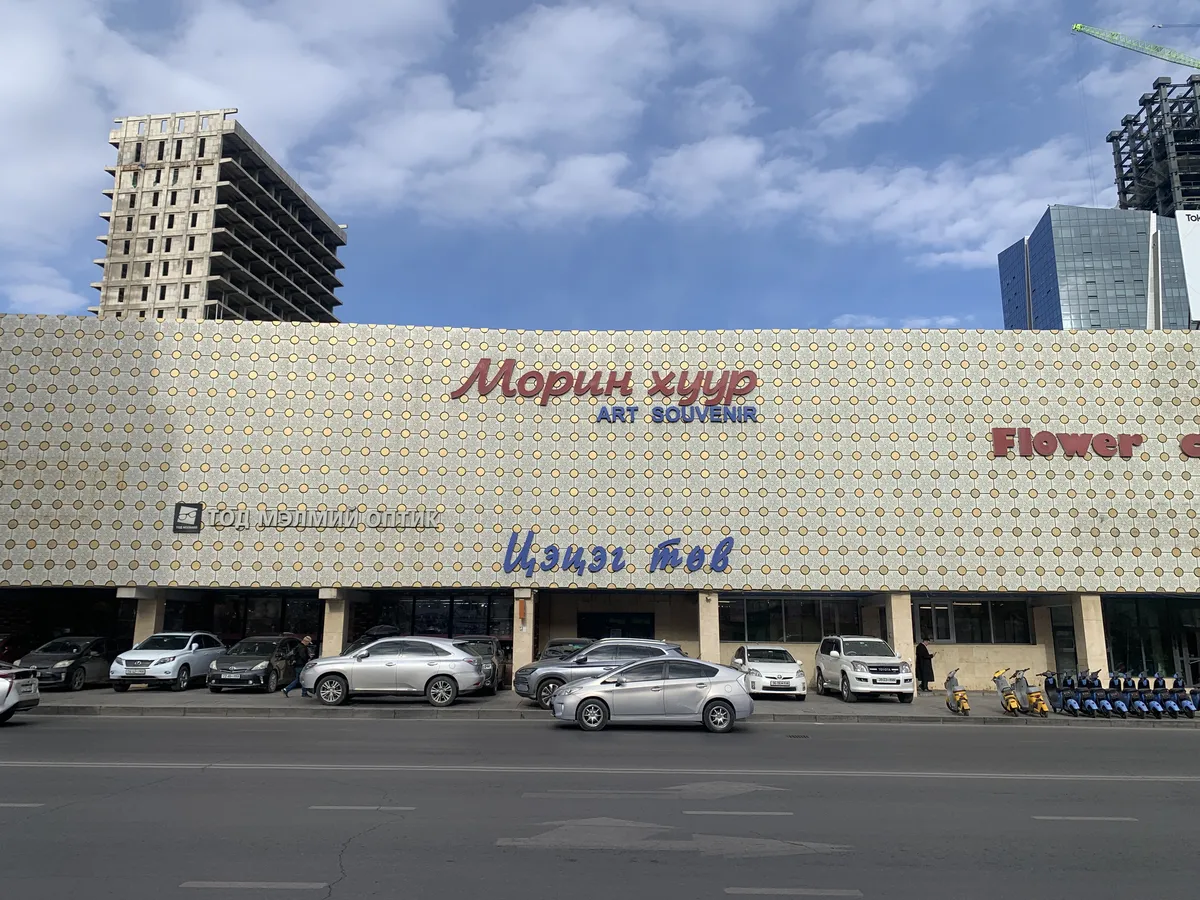 A very Soviet-feeling building in downtown UB
I will say that I understand why some people choose organised tours when they come to Mongolia. For Canadians, as I imagine most Europeans, you can enter visa-free for only a month (although you can extend for another month if you need), which could be a good chunk of time to self-organize a trip in smaller or more organized countries, but it honestly isn’t enough time for a country as vast and offline as Mongolia. Further to this, Mongolia is: one of the least dense places in the world, making travelling between some areas a 1-2 day process; has a long-distance transit system that is still slightly undeveloped, with no formal buses or trains between cities that are not UB (e.g. only shared taxis/minivans between Edernet and Moron, both large regional cities); does not have a lot of english spoken, even in touristy areas; and prefers for a lot of stuff (rentals, bookings, excursions) to be sorted out on the phone, rather than online, and usually the day or week of haha.
In addition, there are just comical things about travelling Mongolia that can make it tiring as a DIY traveller... For example, when going to their main international airport, Google Maps will take you to the old airport (they built a new airport and named it after the old airport); when taking a bus out of UB, you will notice they have two main bus terminals both called "Dragon Bus Terminal" and both are just a 1-2km apart and your bus ticket will just say "Dragon bus terminal"; and when paying for any tourist related stuff (hostels, excursions, rentals), most places will accept cash only but Mongolia's largest bill ($20k Mongolian Tugriks) is only abut $8 CAD (perhaps due to inflation?), which means you will need to carry a THICK wad of cash sometimes and not all ATMs will work.
Thus, while you can piece together your own trip, it will involve lots of planning once you arrive, along with a lot of commuting (think 8-12 hour bus rides), lots of waiting (some buses only go every other day), lots of confusion, lots of cash in your hands, and lots and lots of google translate, which doesn’t work well for Mongolian (it won't let you hear the translations and I found it just gave very strange responses sometimes).
An organized tour is therefore like this plug-and-play system, which is good if you want to SEE Mongolia and not worry about the logistics. DIY travelling is more for those who want to spend more time TRAVELLING in Mongolia (e.g. thinking about which bus to take, getting a little lost, spending time translating and still being confused). I don’t mean to sound condescending and act like “ohhhh travelling DIY is real travelling” and is better than “seeing”, as I think they both just depend on what your desires are for your trip. However, I do personally prefer to sort things out myself and take the longer route through local buses and trains and boats and to try to stay with locals as much as I can. I (usually) find enjoyment in the chaos in slow travel and I did enjoy being in a place that challenges you as a traveller (so much travelling now can be so easy!).
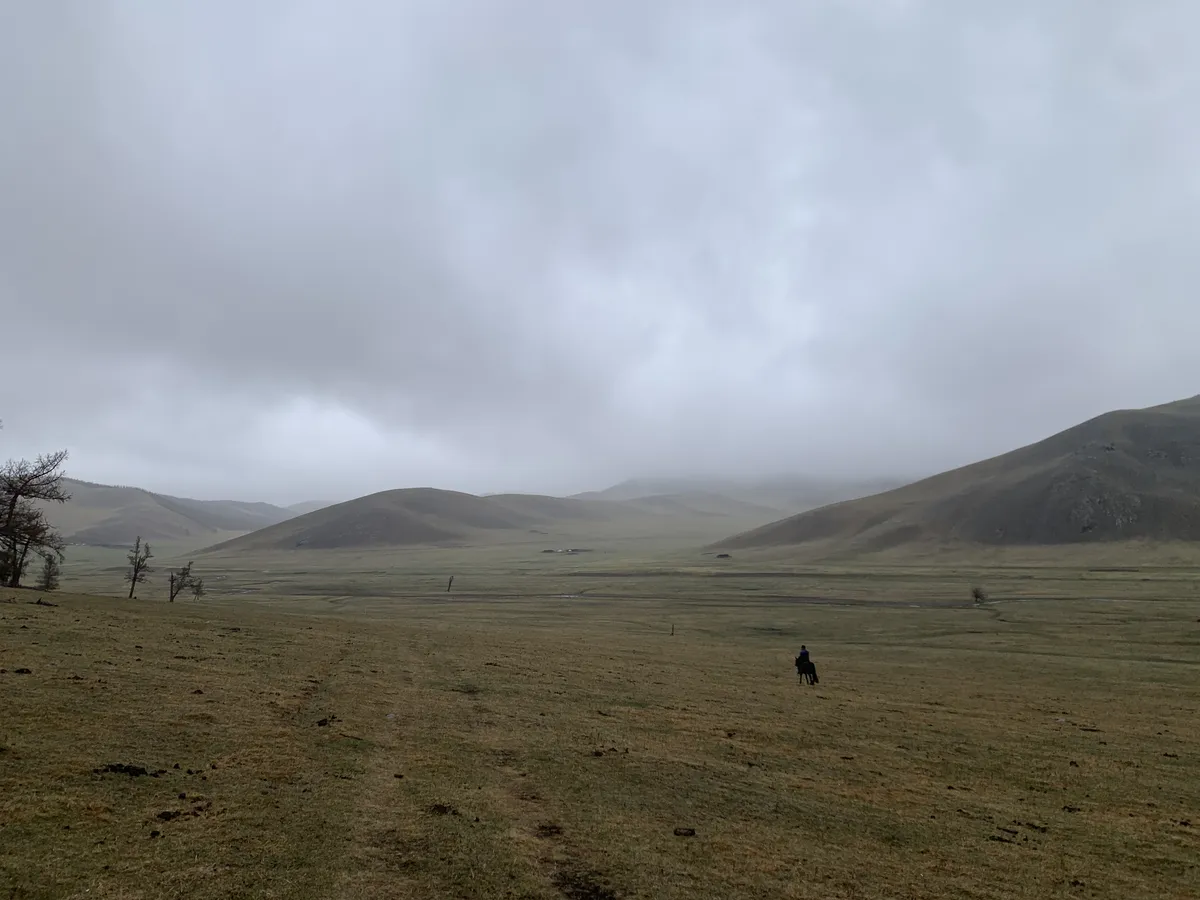 Views of the vast steppes of Orkhon Valley during a work exchange
Yet, I also want to counter a sentiment that I feel sometimes while travelling (and what I catch myself thinking too) - it’s that those who backpack across a country are somehow getting a very "local" experience. I say this because I think a good chunk of Mongolians don't actually travel around their country that often. A person we met in UB said how they only visited the north of the country once in their life, and I think they likely drove with their family in their car. It’s a huge country and most people simply live in their communities, which I think is actually normal in most countries. Most people don’t travel their entire country by public transit, nor travel it often - instead they work, live, and sleep in their communities - so if you are zigzagging through a country, whether it is inside an SUV on a organized tour or through a patchwork of local buses, you are still experiencing the country in a different way, as a foreigner. So, deciding how to travel is all about deciding how you want to be a tourist - neither option will somehow make you a "local" in one month.
Plus, for me, regardless of how I plan my trips, I am realizing I am now a bo-bo (bourgeois bohemian) princess who does enjoys clean sanitation after a week of not showering, does enjoy a soft-ish bed to sleep on, and does enjoy good coffee and chill places to read my book, even if that isn't the local thing to do in that space.
ANYWAYS...
1 Month Itinerary
Here is my rough itinerary of my month in Mongolia
- Day 1-3: Arrive in UB by Train. Explored and hung out in UB. Stayed at a hostel (Old City Guesthouse) and met other travellers. Researched where and what to do in Mongolia.
- Day 4-6: First work exchange on the outskirts of UB. You can read about this experience here.
- Day 7-8: Returned to UB. Met some friends who were also in UB. Stayed at hostel (Top Tours Guesthouse) and met other travellers. Showers, laundry, and nice coffee!
- Day 9-16: Work exchange 2 in Orkhon Valley. You can read about this experience here.
- Day 16-18: Returned to UB. More trip planning. More showers, laundry, and nice coffee.
- Day 18-28: Northern Mongolia Tour (Tsagaannuur & Khövsgöl). You can read about this below.
- Day 29-30: Return to UB. More showers and laundry. Stayed at hostel (Town Yard Hostel). Flight out of Mongolia.
Ulaanbaatar/UB - the city you shouldn't skip
I really enjoyed Ulaanbaatar and would encourage all travellers to spend some time properly getting to know this city. It is a massive, modern city that is buzzing with energy, and is home to almost half of the population of Mongolia. I don’t think I’ve been to a city before that houses so much of a population and, as a city-lover, this was an exciting experience for me.
Some people say you should skip UB and instead focus on exploring the more rural or traditional parts of the country. Yet, to me, if half of the population is urban and based in UB, then you should be taking time to explore and learn about that side of their culture too (if learning about Mongolian culture is your goal). I think it would be strange for someone to visit Canada and not spend some time in Montréal, Toronto, or Vancouver for example, if their goal was to learn about Canadian life/culture.
UB has everything that a millennial-hipster traveler like myself enjoys, having restaurants, shops, and markets showcasing traditional Mongolian life alongside newer, more younger spots serving up sourdough bread, flat-whites, and negronis. During my time in UB, I got to enjoy a drag show at a queer bar (called C.U.M haha), hang out in chill cafes to do some writing (my fav was Donnie's Cafe), visit some museums (Chingiss Khan and National Museum were both alright), and just hang with other travellers and some locals at no-frills bars and restaurants.
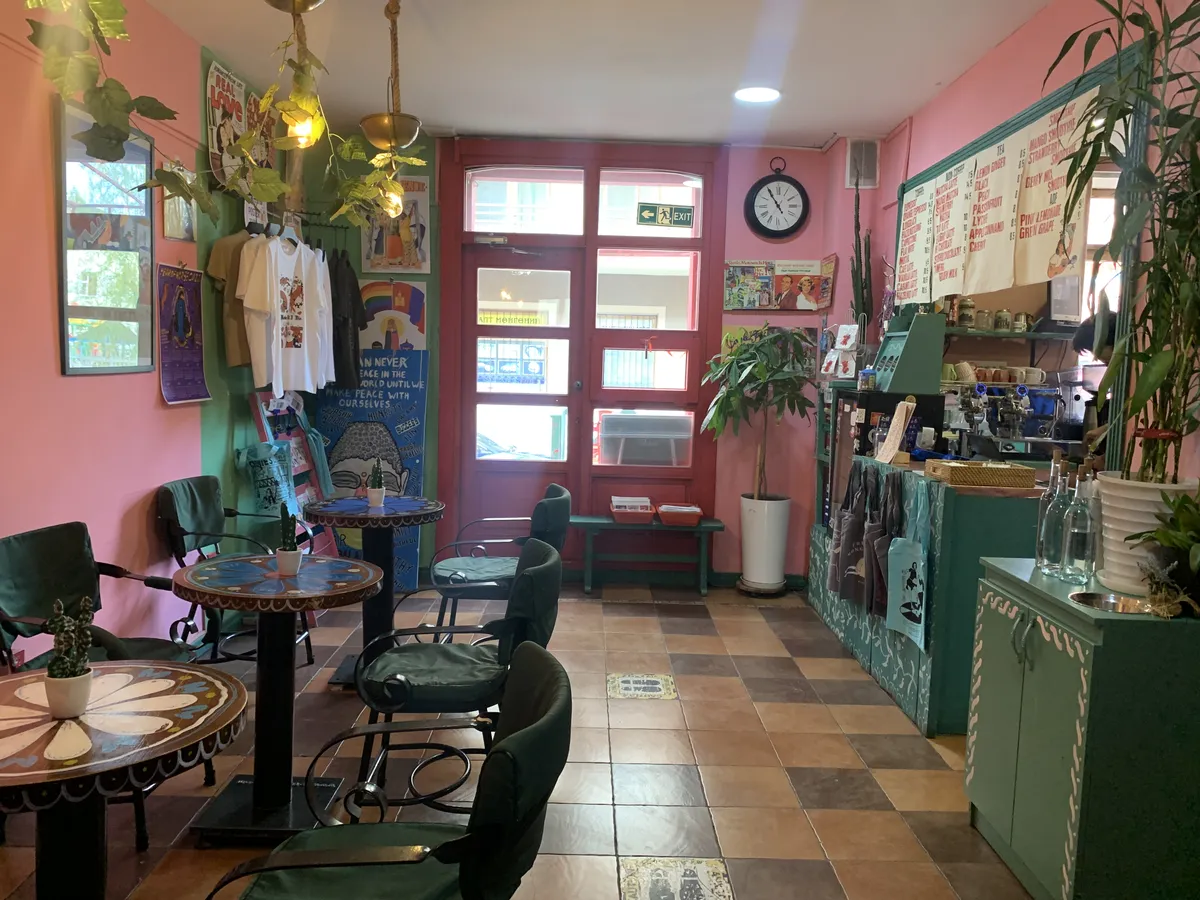 The vibe inside Donnie's Cafe in UB
In UB, I ate a lot of Mongolian food, getting to taste Mongolian milk tea, buuz (Mongolian dumplings), and many hushuurs (large deep fried patty with minced meat). I frequented this a spot called Zochin mongol zoog-4 lot - the ratings were not great online but I really enjoyed the vibes (their sea buckthorn tea was lovely). It also joined many locals in eating some ice cream cones - you will see many tiny ice cream stands dotted all cross town.
There is also a huge Korean influence in UB, with Korean restaurants being quite delicious and being much cheaper than back home in Toronto (where we also have a sizable Korean food scene). I thought I would feel a bigger Chinese or Russian influence in UB, given its proximity to each country, but it was Korean influence that I noticed the most. As you walk the streets in UB, you will see Korean convenience stores, Korean restaurants and Karaoke bars, and Korean products everywhere. I generally don’t frequent convenience stores, but I have to say that I ate a bunch at the CU and GS25 convenience stores for their hushuurs. Outside the major city, you will still find kimbap and ddukbokki everywhere as a local snack, as well Korean skincare products on the selves in small towns. The globalized world is interesting.
I found that people have a feeling of resentment towards Chinese influence on Mongolia, with folks talking negatively about “cheap” Chinese products flooding the country and how resources are being taken out of the country to China, whereas I never really heard anything negative about Korea’s influence. I even heard someone say they don’t like Chinese people because of their role in the fall of the Mongolian empire. While that is indeed hundreds of years ago, it is interesting to note that there are more Mongolians living in China (in Inner or Southern Mongolia) rather than in Mongolia today, so I can see how past tensions can still live on to today. Speaking of pasts - the Soviet era also seemed like a distant memory too, with not much Russian being spoken on the streets and most architecture today feeling more like modern commercial and condo buildings rather than any USSR-styles (Mongolia was never part of USSR but was a satellite state).
Speaking of design, while walking around downtown, you will notice there definitely isn’t a uniform urban design guidelines in UB, with each block (and sometimes even each front yard) feeling like it chooses its own adventure for its type of sidewalk and streetscape. I love cities like this as it gives each street something to explore and it really feels like they are testing 100s of designs in the city to see which one is the best.
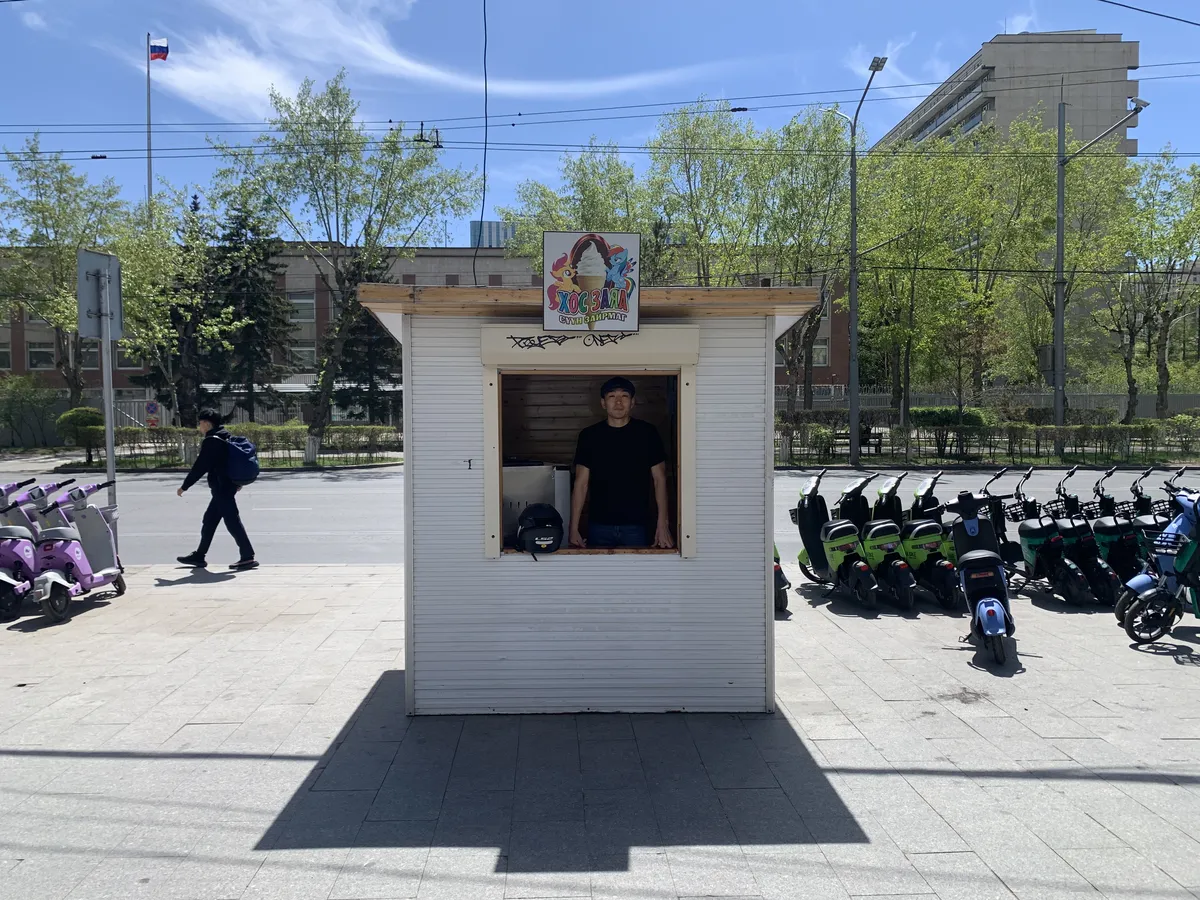 One of the many ice cream stands in UB
However, UB isn’t all roses. Like many major cities, the worst part of UB is the traffic, especially for getting in and out of city’s boundaries. They don’t have major highways, so you must take local roads to enter and exit the city and UB’s roads are essentially gridlocked from 6am to midnight. Coming back from Orkhon Valley, my bus was stuck in bumper-to-bumper traffic just 500 metres from the bus station but it took us another 1.5 hours to get there.
As the city is dominated by cars, pedestrians do not have the right away. Keep this in mind when crossing any streets as cars will not slow down (we even had some cars speed up as we crossed). You are bound to have a close call here and there, so be careful unless you wish to die from a Toyota Prius (as it seems that EVERYONE here drives one). There are cross walks, though, and it seems most drivers respect these downtown (although scooters don’t).
There is no metro in UB, although it’s apparently being planned out, so most people rely on taxi and buses. Buses are only 1000 Mongol Turgriks, which is like 40 cents CDN, and they just take cash or a local bus card. Apparently they do take credit card on some buses, but each time we tried this payment method the driver just told us to skip the payment and waved us on instead. Each bus felt different, which made me think that they just buy whatever buses they can and incorporate them into their fleet.
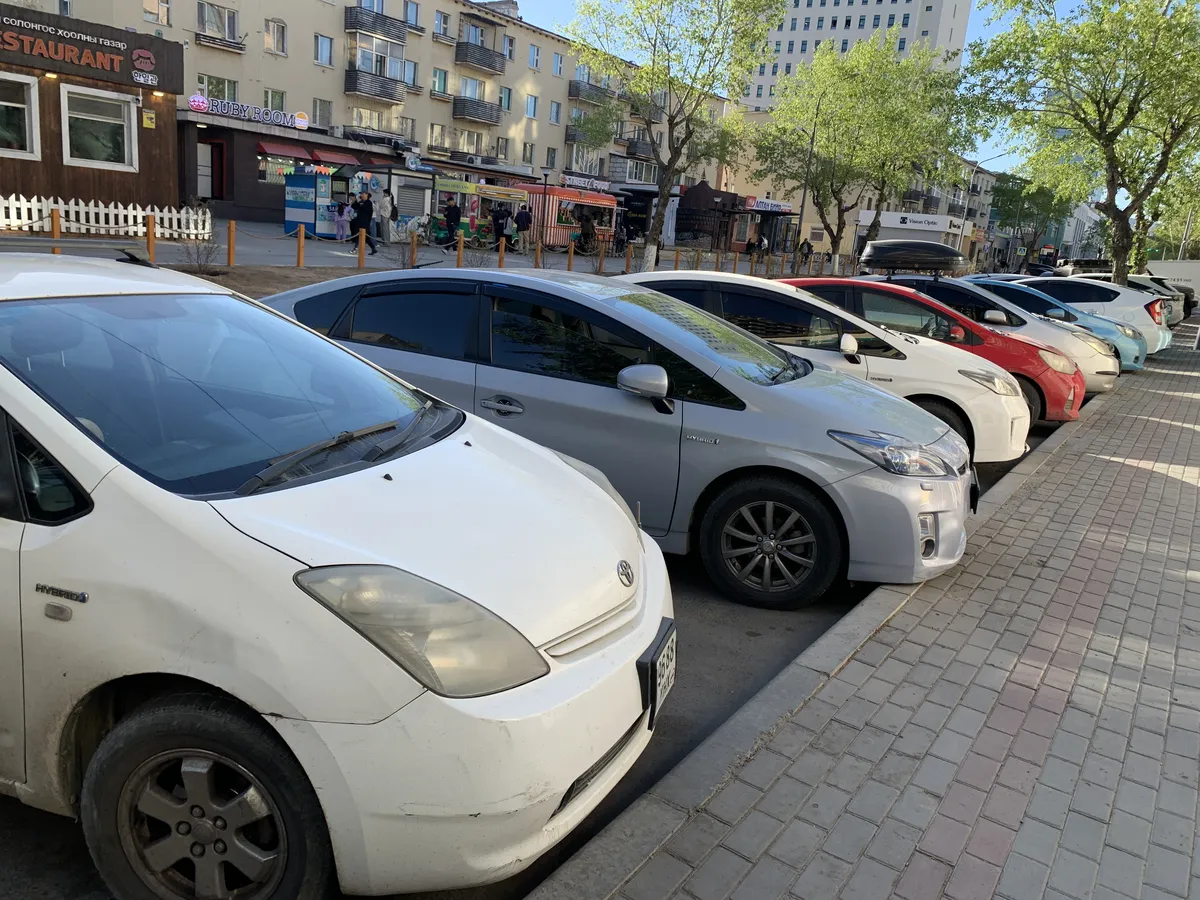 *A row of Toyota Priuses is seen in UB. Interestingly, cars in UB are both right-hand and left-hand drive, meaning you will see cars imported from both Japan and Korea.
To get around in a rush, we used the Mongolian rideshare app called “UBCab” to hail taxis. The app is nice as you can see who the driver is and you can rate them (providing a level of transparency against shitty drivers), but you cannot pay with a foreign credit card (so exact cash is needed) and you will need a local phone number to create an account. The app also doesn’t show the driver where you are going or where you are exactly for pick-up for some odd reason, so expect the driver to call you every time before pick up to see where you are. Also expect to coordinate with the driver once you are in the car on to where you are going. We also had drivers ask us to cancel the ride a few times so they could avoid paying UB cab any fees - usually this was OK but we did have one driver agree to one price at beginning and then change the price at the end. We just gave him the original amount and then left - thankfully it was during the day and in a busy area. He wasn't happy though.
A positive story with UBCab was that on our 2nd time using the app we managed to get a driver who spoke pretty good English (and Korean too!), offering a pleasant ride through the city’s gridlock. Thanks to my partner's openness to meeting strangers, we invited the driver out for Korean food and got to learn more about local life in UB. This person, who worked as a police officer, told us that they can make more money using UB cab than they can as a police officer, which was quite surprising to hear.
Work Exchanges in UB & Orkhon Valley
- Read about my first work exchange on the outskirts of UB here.
- Read about my second work exchange in Orkhon Valley here.
Tsagaannuur & Khövsgöl
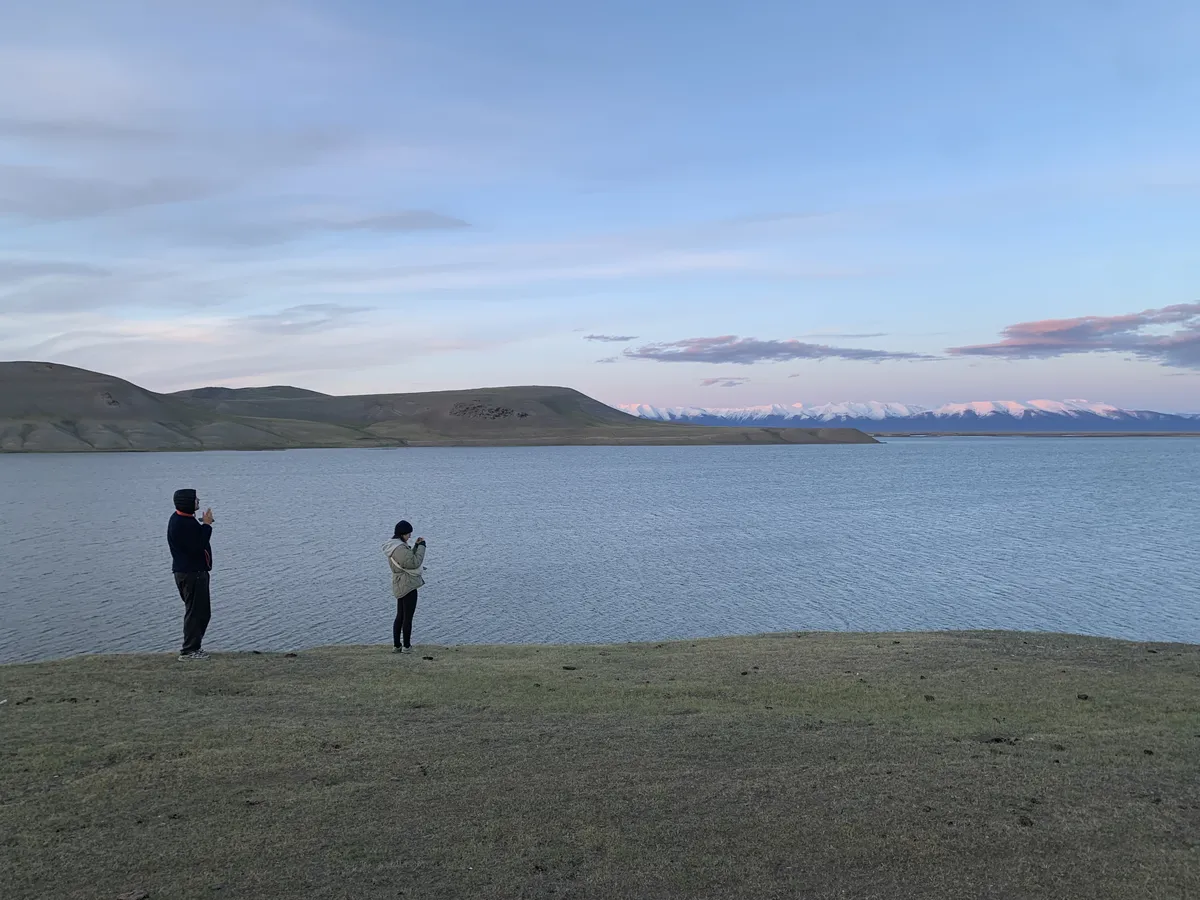 Catching a sunset in Tsagaannuur with some travellers from France I met
The area around Tsagaannuur & Khövsgöl lake in Northern Mongolia is a different ecosystem, changing from the open and vast (and more dry) steppes of the centre of the country to a mountainous, boreal (taiga) rich forest area, which sprawls up into Siberia. It's quite the experience to see the steppes contort themselves into pine-filled, snow covered mountains.
Coming from Canada, it seems a bit funny to travel to all the way to Mongolia to visit an area with a very similar forest (as Canada is part of the same boreal forest zone), but the Tsagaannuur area is very unique and was special to me. First, the area is home to nomadic families that herd reindeer (which feels so wild to me). Second, as I have never been to the Northern Territories in Canada like Yukon, I have never seen a scenery like Tsagaannuur before with large open valleys mixed with mountains.
In Tsagaannuur, the Tsaatan peoples, also known as the Dukha, are this VERY small community of semi-nomadic reindeer herders living in the deep north. When I say small, it is very small, with only around 60-70 families left living this lifestyle. The area we visited, which was in the East Taiga, only had around 20 families left living on the land in this way.
These folks are the last reindeer herders in Mongolia, and I think are the most southern reindeers herders in the world. They live in teepees, which are called orts, and must move their camps to stay within the coldest areas for their reindeer, changing places around 6-8 times a year (which is much more than other nomadic families in Mongolia).
I think climate change and the warming of Mongolia will start to pose some issues for this nomadic way of living and herding. These families only have so many cold areas to take the reindeer for grazing since this ecosystem doesn't extend too far south into Mongolia and the border of Russia blocks them from going more north (there are other reindeer herders in Russia). Knowing this, it felt really strange to be with a culture that may not continue to properly exist in my lifetime.
The Tsaatan people speak a different language from Mongolians, with their language (Dukhan) being closer to Turkish. They are also ethnically a Turkic people, being closer to Central Asians like the Krygz then Mongolians. To say hello in Dukhan, you say "Ekii" or "Eh-kee". I don't think I have ever met people that spoke such an endangered language before so it was a bit emotional to think that maybe this language too may soon cease to exist. Negatives thoughts in a beautiful place!
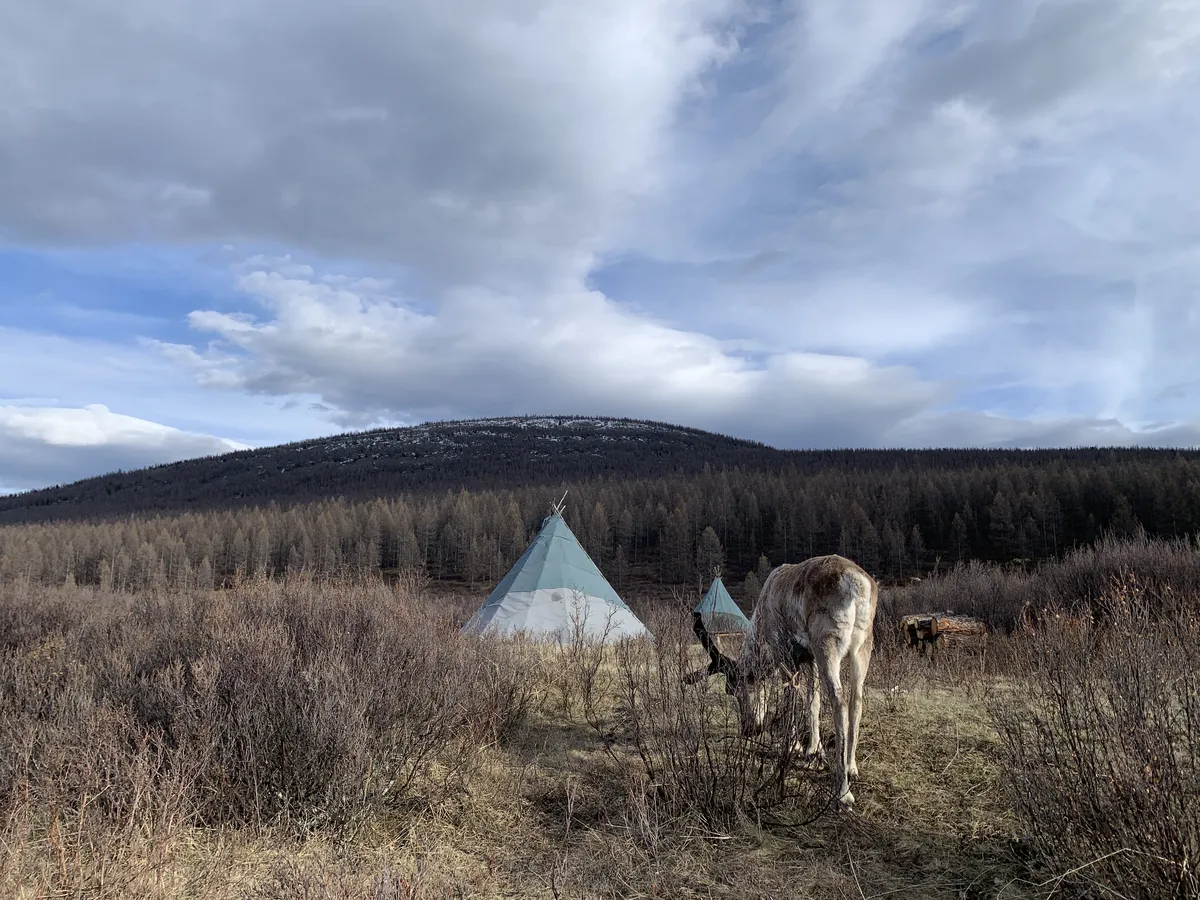
We spent 2 nights with the Tsaatan familes in East Taiga as part of a tour we arranged with a tour guide/guesthouse operator in Tsagaannuur named Ollzii. My partner had gotten Ollzii's contact info from contacting a French couple who had left a rave review in a guestbook at our first work exchange (the guestbook had asked for visitors to provide advice to other travellers and this couple had recommended to work with Ollzii). It felt nice to get advice in a more oldschool way rather than reading 4000 reviews on Tripadvisor... After many messages and calls on Whatsapp to our future guide, Ollzii, we set off to meet him in Tsagaannuur.
The trip from UB to Tsagaannuur is not short. It first involves a 13 hour bus ride from UB to Mörön, which we did during the day. The ride honestly wasn't too bad given the amount of stops it makes and the awesome homecooked meals you get at these stops. We then stayed a night in Mörön (just to sleep, eat, and shower) and then began a 10-11 hour, very bumpy, off-road car ride to Tsagaannuur. This ride from Mörön was organized by Ollzii and was part of a 6-day trip we booked with him, which we did alongside with 3 other travellers we met in UB. We convinced them to come with us to help lower our costs and because they seemed cool! After arriving in Tsagaannuur, we spent the night there and the next day set off again for another 1.5 hour drive to a nomadic family's house in the northern steppes. After a night there, which involved sleeping in another ger and getting to eat homemade bread, we then began a horseback trip through the mountain forests, taking about 2-3 hours before we met the Tsaatan families. There were no cars in this area at this time of the year, only horses and... reindeer!
We were lucky because Ollzii was from the Tsaatan tribe, with his father having been born and raised in the teepees. His dad left the nomadic life to become a doctor, but still came back often as the region's travelling doctor. Ollzzii was therefore raised in the town of Tsagaannuur, but left to go to university in UB where he learned English and started working in tourism. Ollzzii only returned to Tsagaannuur a few years ago, which was luck for us!
Ollzzii striked this perfect balance for a guide - he was fluent in English and super easy get along with, but was still be related to those in East Taiga (the people we stayed with were actually his cousins). It felt like a very local experience for us, but with the added comfort of being with someone who we could joke with and have long conversations with in English. Such a joy after spending many other encounters talking through Google Translate.
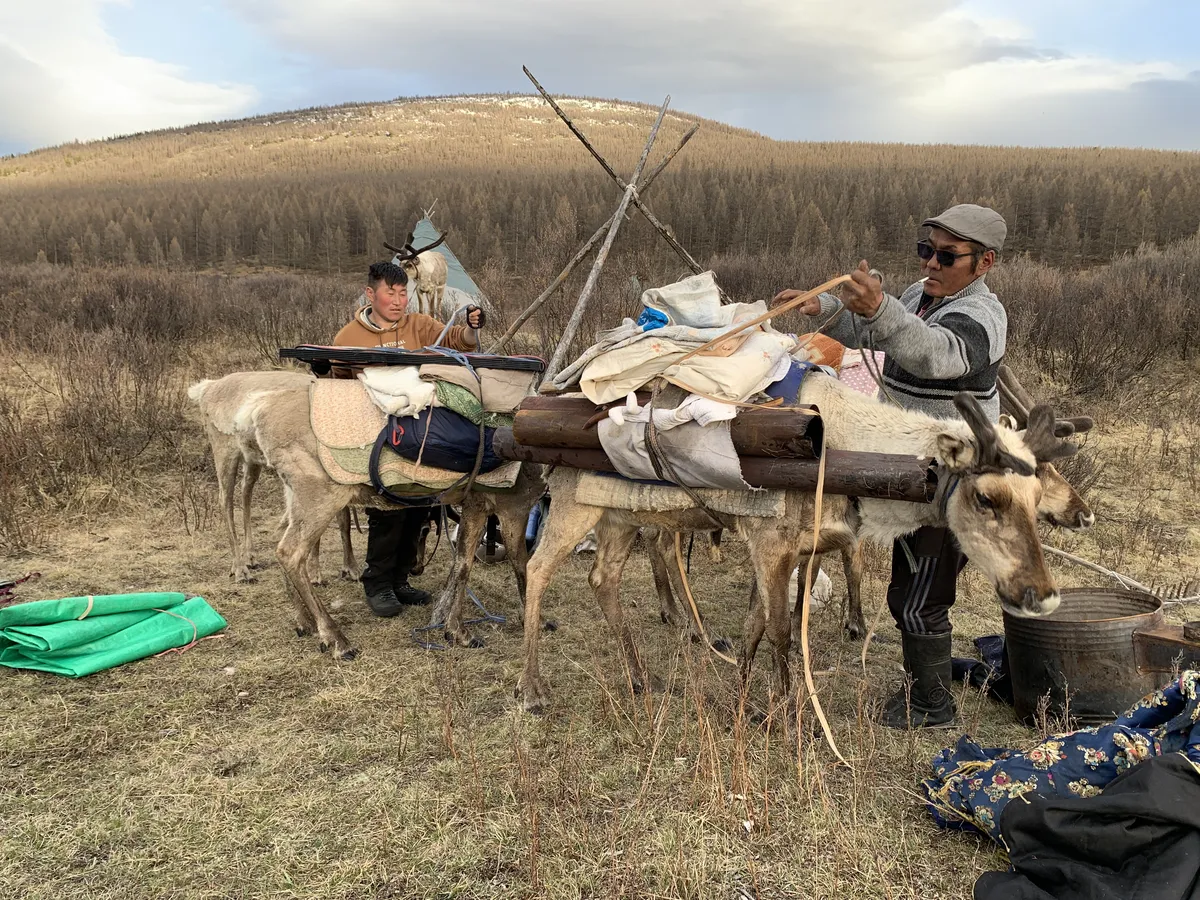
We ended up staying 2 nights in the teepees with the Tsaatan people, spending our time helping them change camp locations and helping them herd their reindeer (which we got to do on horseback and I loved). We also got to ride reindeer, which felt very slippery and low to the ground, as well as try to milk reindeer (as this is how they get their dairy). I failed at milking.
The area was outstandingly beautiful, with snow-capped mountains hugging the horizon, shrubs, lichen, and artic-rivers lining the grounds, and deep green boreal forests rising up on the edges of the community. On our first night, we got hit with snow and I remember waking up the next morning to the sight of roaming (and groaning) reindeer and dozens of teepees covered in beautiful white snow. Little puffs of smoke were rising from the teepees towards the sky. It felt like a fantasy of what "the north" would look like to a child.
We then left the remote area and headed back to the village of Tsagaannuur, staying for another night with Ollzzii and being able to explore the town a little bit. It's located on a lake (Tsagaan = white in Mongolian, nuur = lake) and it was such a quiet and peaceful town. Ollzzii took us to the local grocery shops and toured us around. It felt strange to be a town with a gas station, about a dozen little markets, a bank, and plenty of houses, but the nearest paved road was at least 10 hours away. They had electricity, which was ran all the way from Mörön, but no running water or sewage.
After Tsagaannuur, we drove a different route home, this time going through the mountains (for another 11 hours off road) to get to Khatgal, which is at the base of the famous Khövsgöl lake. I honestly preferred the lake at Tsagaannuur (you get better views of the mountains), but Khatgal does act as a good base for tours and has more urban options (restaurants, cafes, plenty of guesthouses, and a paved road!). We stayed at MS Guesthouse in Khatgal for 2 nights and enjoyed the luxuries of hot water, heated rooms, and a diversity of food again. After that, we went back to Mörön (getting a ride from some friends who were passing through in their van) and then took our 13 hour bus back to UB.
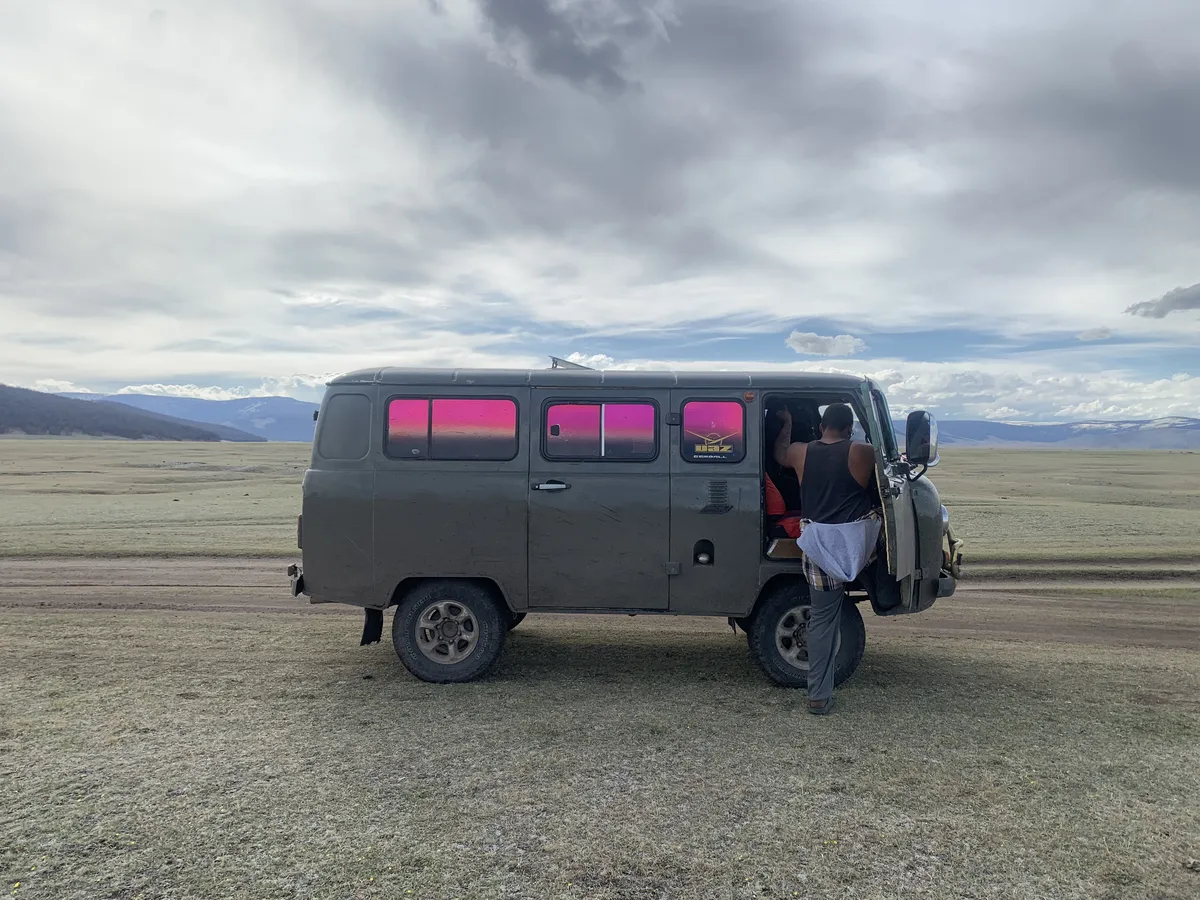 Our van for 11 hours from Moron to Tsagaannuur